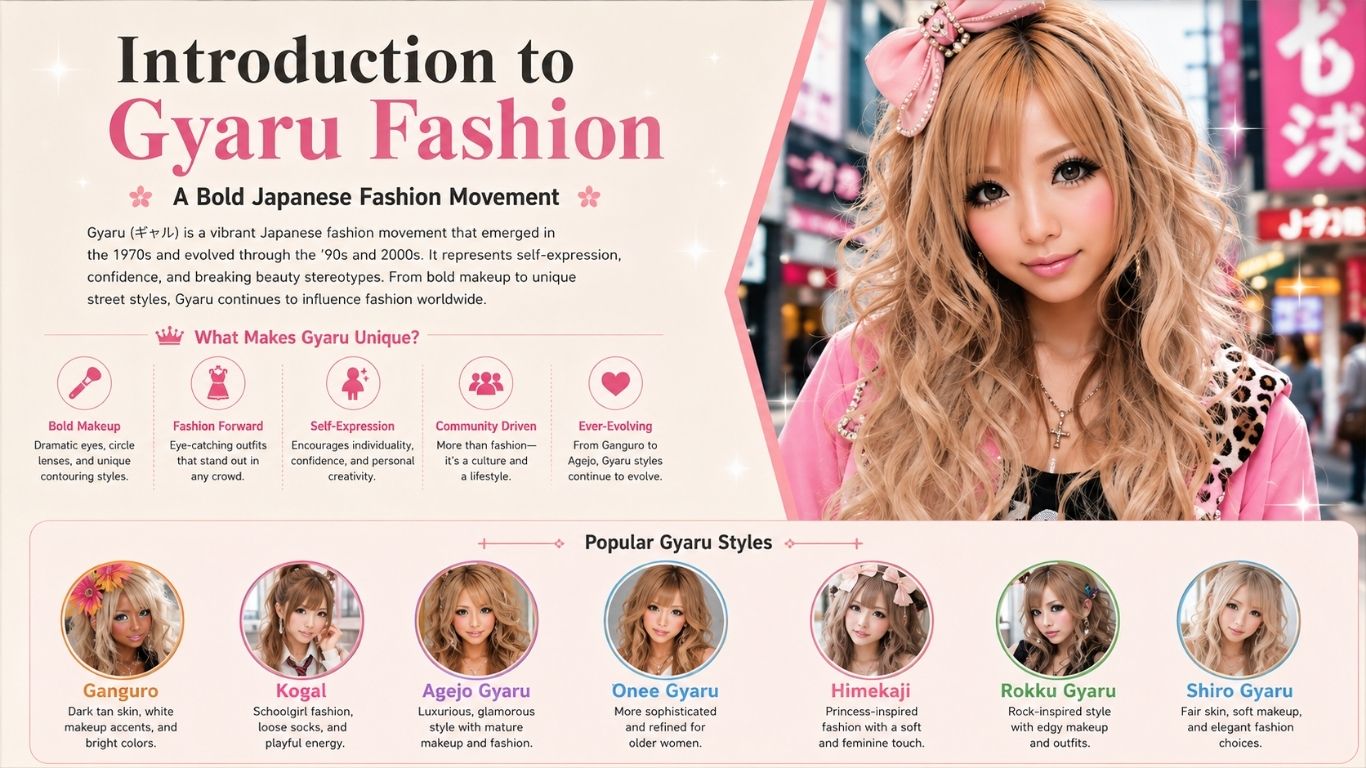
Japanese street fashion has produced countless trends over the years, but few have been as influential, controversial, and recognizable as Gyaru. Known for its bold approach to beauty, fashion, and self-expression, Gyaru became one of the defining youth subcultures in Japan during the 1990s and early 2000s. What makes Gyaru especially fascinating is that it isn’t a single fashion style. Instead, it consists of numerous substyles, each with its own aesthetic, philosophy, and cultural significance.
From the deeply tanned and rebellious look of Ganguro to the elegant sophistication of Agejo and Onee Gyaru, the movement evolved into a diverse fashion ecosystem that allowed people to express different personalities through clothing, makeup, hairstyles, and accessories. Understanding these styles provides valuable insight into Japanese fashion history and helps modern fashion enthusiasts discover which Gyaru aesthetic best suits their preferences.
In this guide, you’ll learn about the origins of Gyaru, why so many substyles emerged, and how iconic fashion movements like Ganguro and Kogal helped shape Japanese street culture.
What Is Gyaru Fashion?
The Meaning of Gyaru
The word “Gyaru” originates from the English word “gal,” which was adopted into Japanese culture and eventually became associated with a distinctive fashion movement. While the term initially referred to fashionable young women who embraced modern trends, it gradually evolved into a broader identity that represented individuality, confidence, and rebellion against traditional beauty standards.
Unlike many fashion trends that focus solely on clothing, Gyaru developed into a lifestyle and cultural statement. Followers often experimented with hairstyles, makeup techniques, nail art, accessories, and fashion choices that contrasted sharply with conventional expectations. During a period when pale skin, natural hair, and modest appearances were widely celebrated in Japan, Gyaru encouraged young women to challenge those norms and create their own standards of beauty.
Over time, the movement expanded beyond a single look. Different communities adopted unique interpretations of the aesthetic, resulting in numerous substyles that continue to influence fashion enthusiasts today. This flexibility is one of the reasons Gyaru remains relevant decades after its peak popularity.
Origins of the Gyaru Movement
The roots of Gyaru can be traced back to Japan’s economic boom during the late 1980s and early 1990s. As consumer culture expanded and fashion magazines gained influence, young people became increasingly interested in expressing themselves through style. The districts of Shibuya and Harajuku emerged as important centers for experimentation, where fashion-forward teenagers gathered to showcase new trends and challenge traditional expectations.
Many researchers believe Gyaru developed partly as a reaction against rigid social norms. Japanese society historically emphasized conformity, particularly among young women. Gyaru represented an opportunity to stand out rather than blend in. Brightly dyed hair, bold makeup, and eye-catching outfits became symbols of independence and self-expression.
Fashion magazines played a crucial role in spreading the movement. Publications featured influential models who introduced readers to emerging trends, helping Gyaru evolve from a local fashion phenomenon into a nationwide cultural movement. As popularity grew, different interpretations emerged, eventually giving rise to the many Gyaru substyles recognized today.
How Gyaru Became a Japanese Fashion Phenomenon
What transformed Gyaru from a niche trend into a cultural phenomenon was its ability to continuously reinvent itself. Unlike fashion movements that disappear after a few years, Gyaru adapted to changing tastes and social environments. New styles emerged, magazines promoted fresh aesthetics, and fashion brands created products tailored specifically to different segments of the community.
During the late 1990s and early 2000s, Gyaru dominated Japanese youth fashion. Celebrities, models, and influencers embraced various versions of the aesthetic, helping it gain widespread visibility. Fashion districts became gathering places where enthusiasts could showcase their outfits and connect with others who shared similar interests.
Another reason for Gyaru’s success was its inclusivity. The movement offered multiple ways to participate, whether someone preferred dramatic fashion, elegant styling, punk influences, or romantic aesthetics. This diversity allowed the subculture to appeal to a wide audience while maintaining its core values of individuality and confidence. Even today, many modern fashion communities draw inspiration from ideas that originated within Gyaru culture.
Why Are There So Many Types of Gyaru?
Evolution of the Subculture
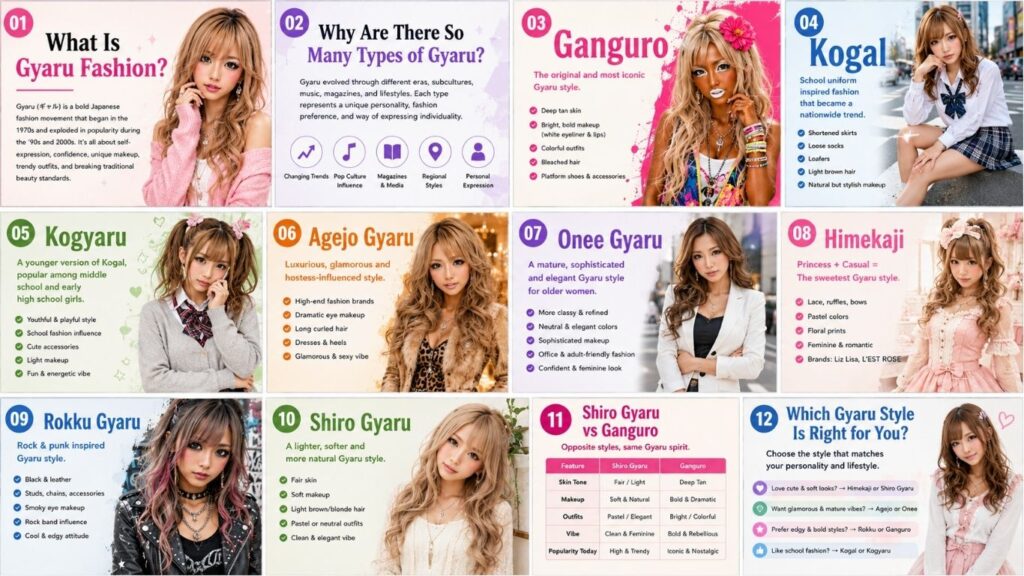
One of the most remarkable aspects of Gyaru is its diversity. Rather than remaining a single fashion trend, the movement evolved into a collection of interconnected substyles. This evolution occurred naturally as participants adapted the aesthetic to suit their personal tastes, lifestyles, and influences.
As the community expanded, some individuals gravitated toward glamorous luxury fashion, while others preferred casual streetwear, punk-inspired outfits, or princess-themed looks. Instead of creating division, these differences enriched the movement and encouraged creativity. Each new interpretation contributed to the broader Gyaru identity while maintaining a distinct visual language.
This constant evolution helped Gyaru remain relevant across multiple decades. Whenever one style began to decline, another emerged to capture attention. The result was a dynamic fashion culture that continuously reinvented itself while preserving its emphasis on self-expression.
Influence of Japanese Pop Culture
Japanese pop culture played a major role in shaping the development of different Gyaru styles. Television personalities, musicians, fashion models, and magazine editors all contributed to the movement’s growth. Popular figures often introduced new trends that quickly spread through fashion communities and inspired countless followers.
Fashion magazines were particularly influential because they provided visual guides for readers. Entire issues were dedicated to styling tips, makeup tutorials, and wardrobe recommendations. Readers could easily replicate looks or adapt them to create their own unique versions of the aesthetic.
Anime, manga, and celebrity culture also influenced the movement. As different forms of media gained popularity, elements of those styles began appearing within Gyaru fashion. This ongoing exchange between entertainment and street fashion helped generate many of the substyles that continue to be discussed today.
Fashion Trends That Created New Substyles
The creation of new Gyaru substyles was often driven by broader fashion trends. Luxury fashion inspired Agejo Gyaru, while rock music contributed to the development of Rokku Gyaru. Romantic and feminine trends helped shape Himekaji, while changing beauty standards influenced the rise of Shiro Gyaru.
Each substyle emerged because a group of fashion enthusiasts wanted to express a specific aesthetic while remaining connected to the broader Gyaru identity. Rather than abandoning the movement entirely, they adapted it to reflect new interests and cultural influences.
This process explains why Gyaru contains such a wide range of visual styles. Despite their differences, these substyles share common themes such as confidence, creativity, and individuality. Understanding these connections makes it easier to appreciate the movement as a whole rather than viewing each style in isolation.
Quick Comparison of Major Gyaru Styles
Before exploring individual styles, it helps to compare their defining characteristics.
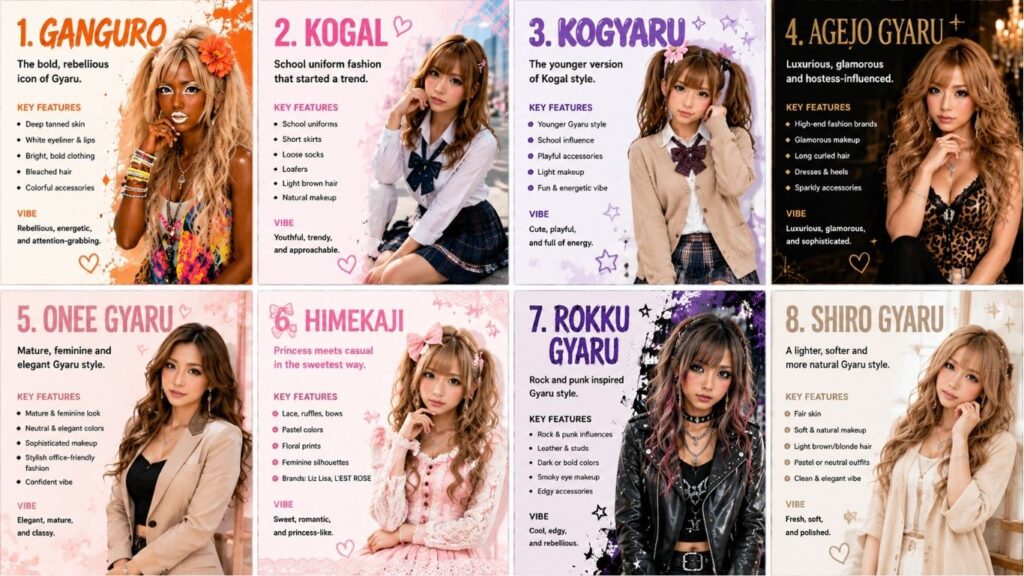
| Style | Main Characteristics | Makeup Style | Overall Aesthetic |
|---|---|---|---|
| Ganguro | Deep tan, bright clothing | Dramatic contrast | Rebellious |
| Kogal | Modified school uniforms | Natural glam | Youthful |
| Kogyaru | Younger Gyaru influence | Light makeup | Playful |
| Agejo | Luxury-inspired fashion | Glamorous | Elegant |
| Onee Gyaru | Mature styling | Sophisticated glam | Feminine |
| Himekaji | Princess-inspired casual wear | Soft feminine makeup | Romantic |
| Rokku Gyaru | Rock and punk influences | Smoky eyes | Edgy |
| Shiro Gyaru | Light-toned aesthetic | Soft glam | Clean and polished |
Ganguro
What Is Ganguro?
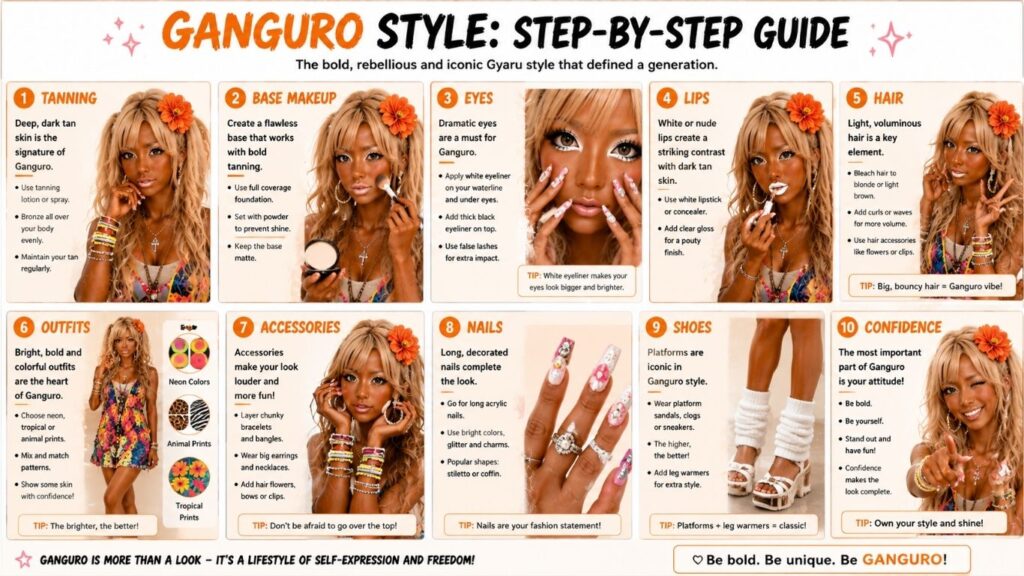
Among all Gyaru substyles, Ganguro is arguably the most recognizable and controversial. Emerging during the late 1990s, Ganguro challenged traditional Japanese beauty standards by embracing deeply tanned skin, bleached hair, dramatic makeup, and brightly colored clothing. At a time when fair skin was widely considered desirable, Ganguro represented a deliberate rejection of conventional expectations.
Many outsiders viewed the style as shocking because of its dramatic appearance. However, participants often described it as a form of self-expression rather than simple rebellion. By creating a look that stood in direct contrast to mainstream beauty ideals, Ganguro enthusiasts established a powerful visual identity that quickly attracted attention throughout Japan.
The style became one of the most photographed and discussed fashion trends of its era, helping introduce international audiences to the broader Gyaru movement.
Key Fashion Elements
Ganguro fashion emphasizes visibility and confidence. Bright colors, platform shoes, mini skirts, bold accessories, and eye-catching patterns are all common components of the aesthetic. Clothing is designed to stand out rather than blend into the crowd.
Accessories often include colorful bracelets, large earrings, statement necklaces, and decorative hair pieces. Many followers also embraced tropical-inspired themes, incorporating vibrant colors and playful designs into their outfits. The overall appearance reflects a carefree attitude that prioritizes individuality over conformity.
Unlike minimalist fashion trends, Ganguro celebrates excess and creativity. Every element contributes to a distinctive visual impact that makes the style instantly recognizable.
Typical Makeup Style
Makeup is one of the defining features of Ganguro. The look traditionally includes dark tanning combined with white eyeliner and white concealer around the eyes and lips. This contrast creates a dramatic effect that distinguishes Ganguro from other Gyaru styles.
Heavy mascara, false lashes, and brightly colored eye shadows are commonly used to enhance the eyes. The goal is to create a striking appearance that appears almost theatrical while remaining fashionable. Makeup application often requires considerable skill, making it one of the most recognizable aspects of the subculture.
Many modern beauty enthusiasts continue to study Ganguro techniques because of their historical significance and influence on later makeup trends.
Hairstyles and Accessories
Hair plays a crucial role in completing the Ganguro look. Bleached blonde hair became one of the style’s signature features, although lighter shades of brown and other vibrant colors were also popular. Large curls, teased volume, and decorative accessories helped create an energetic and glamorous appearance.
Accessories often reflected the playful nature of the fashion. Flower clips, colorful jewelry, platform sandals, and oversized sunglasses were common choices. These additions reinforced the style’s emphasis on individuality and visual impact.
Together, the hair and accessories helped transform Ganguro into more than a makeup trend. They contributed to a complete aesthetic identity that influenced Japanese street fashion for years.
Why Ganguro Became Famous
Ganguro became famous because it challenged expectations in a way few fashion trends had done before. Its dramatic appearance generated media attention, public debate, and widespread curiosity. While some critics viewed the style negatively, supporters appreciated its bold celebration of self-expression.
The trend also benefited from extensive magazine coverage and strong visibility within fashion districts such as Shibuya. As images of Ganguro enthusiasts spread through media outlets, the style became synonymous with the broader Gyaru movement.
Even though its peak popularity has passed, Ganguro remains one of the most influential fashion subcultures in Japanese history and continues to inspire designers, artists, and fashion enthusiasts worldwide.
Kogal
What Is Kogal?
Kogal is one of the most influential and culturally significant branches of Gyaru fashion. Unlike Ganguro, which focused on dramatic visual transformation, Kogal developed around the reinterpretation of Japanese school uniforms. The style emerged during the 1990s and quickly became associated with youth culture, trendsetting behavior, and urban fashion communities.
Rather than wearing school uniforms exactly as intended, followers personalized them to create unique looks. This customization transformed ordinary clothing into fashionable statements and helped establish Kogal as a defining symbol of Japanese youth culture.
The style’s popularity extended far beyond fashion, influencing language, technology trends, consumer behavior, and media representation throughout Japan.
School Uniform Inspiration
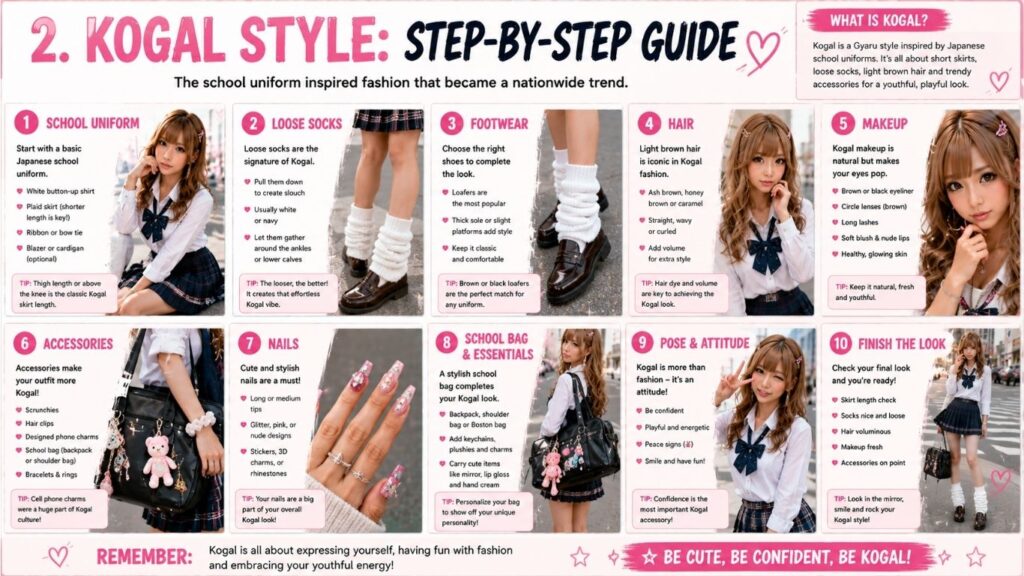
The foundation of Kogal fashion lies in the Japanese school uniform. Enthusiasts modified traditional uniforms by shortening skirts, wearing oversized cardigans, and pairing outfits with loose socks and fashionable accessories. These adjustments allowed wearers to express individuality while remaining connected to recognizable elements of student life.
The aesthetic resonated strongly with teenagers because it balanced familiarity with creativity. Rather than rejecting school culture entirely, Kogal transformed it into a platform for personal expression.
This innovative approach helped distinguish Kogal from other fashion movements and contributed significantly to its widespread popularity.
Fashion Characteristics
One of the reasons Kogal became such a powerful force in Japanese youth culture was its ability to transform everyday clothing into a fashion statement. While the school uniform served as the foundation, the styling choices made all the difference. Kogal enthusiasts developed recognizable trends that allowed them to stand out while remaining connected to a shared aesthetic.
Loose socks became one of the most iconic elements of the style. Originally popularized through school fashion trends, these oversized socks were often paired with loafers and shortened skirts to create a distinctive silhouette. Hair was frequently dyed brown or lightened from its natural color, which contrasted with traditional expectations surrounding student appearance. Accessories such as designer handbags, mobile phone charms, and branded items became important status symbols within the community.
Makeup was generally softer than what was seen in Ganguro fashion. Instead of dramatic contrast and extreme tanning, Kogal focused on polished beauty, healthy-looking skin, and subtle eye enhancement. This made the style more accessible to a broader audience and helped it achieve mainstream popularity.
What made Kogal especially influential was its balance between rebellion and wearability. The fashion pushed boundaries without becoming completely disconnected from everyday life, allowing it to spread rapidly among young people throughout Japan.
Cultural Impact
Few Japanese fashion movements have had the cultural impact of Kogal. During the 1990s and early 2000s, the style became closely associated with urban youth culture and helped define an entire generation’s identity. Fashion magazines, television programs, and advertising campaigns frequently featured Kogal-inspired looks, bringing the aesthetic into mainstream consciousness.
The influence extended beyond clothing. Kogal communities were early adopters of mobile communication technology, helping shape trends that would later become standard among young consumers. Language, social habits, and entertainment preferences were all influenced by the movement. For many observers, Kogal represented a new form of youth independence and cultural expression.
The style also played a significant role in shaping international perceptions of Japanese street fashion. Images of Kogal enthusiasts appeared in magazines and documentaries around the world, introducing global audiences to Japan’s vibrant fashion culture. Even today, references to Kogal continue to appear in anime, manga, films, and academic discussions about youth subcultures.
While the style has evolved over time, its legacy remains undeniable. Kogal helped establish the foundation upon which many later Gyaru substyles would be built, making it one of the most important chapters in the history of Japanese fashion.
Kogyaru
What Is Kogyaru?
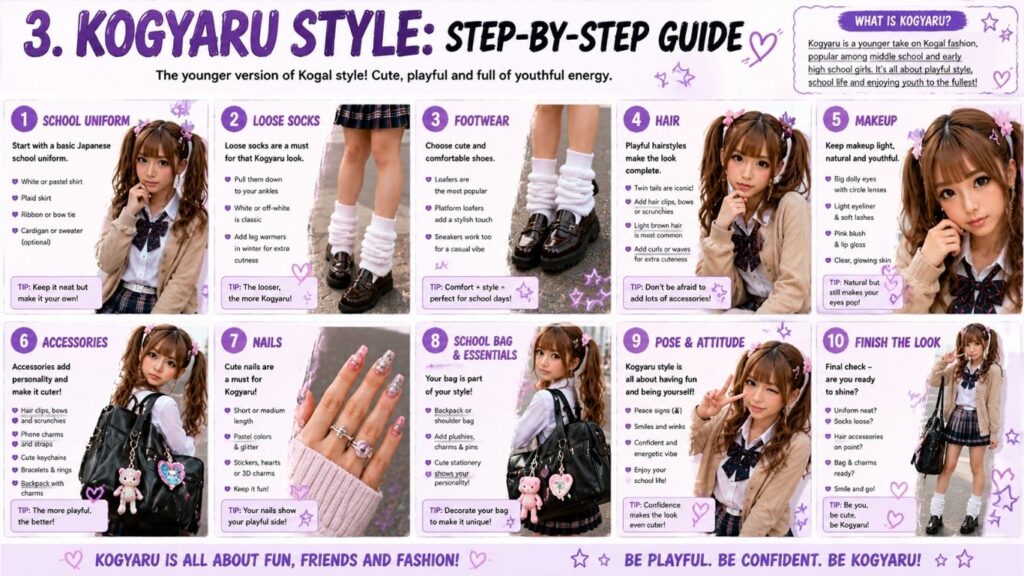
Kogyaru is often mentioned alongside Kogal, and while the two are closely related, they are not exactly the same. The term generally refers to younger participants in the Gyaru movement who embraced many of the trends associated with Kogal fashion. During the height of the subculture, Kogyaru became a recognizable identity within Japanese youth culture and represented a younger, more playful side of the movement.
The style emerged as teenagers began experimenting with fashion in ways that challenged traditional expectations. Clothing, hairstyles, and accessories became tools for expressing individuality and connecting with peers who shared similar interests. Kogyaru was less about achieving a glamorous image and more about participating in a cultural movement that celebrated self-expression.
As fashion magazines and youth-focused media gained popularity, Kogyaru became increasingly visible. Young fashion enthusiasts looked to models and influencers for inspiration, helping establish the style as a recognizable part of Japan’s evolving street fashion landscape.
Although Kogyaru is often discussed from a historical perspective today, its influence can still be seen in modern conversations about youth fashion and the development of the broader Gyaru movement.
Differences Between Kogal and Kogyaru
Because the terms are frequently used interchangeably, many people struggle to understand the distinction between Kogal and Kogyaru. While both styles emerged from similar cultural environments, they represent different segments of the same fashion movement.
| Feature | Kogal | Kogyaru |
|---|---|---|
| Age Group | Older teenagers | Younger teenagers |
| Fashion Focus | School fashion and trends | Youthful experimentation |
| Makeup | Moderate glam | Simpler makeup |
| Accessories | Trend-driven | Playful and casual |
| Cultural Role | Mainstream influence | Entry-level Gyaru identity |
Kogal generally became associated with older high school students who embraced fashion-conscious lifestyles, while Kogyaru referred to younger girls who were beginning to participate in these trends. The differences were often subtle, but they reflected the natural diversity that existed within the movement.
Understanding this distinction helps clarify how Gyaru expanded into different demographics and maintained relevance across various age groups. Rather than functioning as a single unified style, the movement accommodated a wide range of identities and experiences.
Modern Relevance
Although Kogyaru is no longer a dominant fashion category, its historical importance remains significant. Many of the trends associated with youth fashion in Japan can be traced back to the cultural environment that produced Kogyaru. The style demonstrated how young people could use fashion to establish identity, challenge expectations, and participate in larger cultural conversations.
Modern social media platforms have also contributed to renewed interest in historical Gyaru styles. Fashion enthusiasts frequently revisit archival magazine images and discuss the evolution of Kogyaru as part of broader conversations about Japanese street culture. This renewed attention has helped preserve the style’s legacy and introduce it to new audiences.
For those studying the history of Gyaru, Kogyaru serves as an important reminder that the movement was never limited to a single demographic. Its ability to appeal to younger participants helped ensure its continued growth and cultural influence throughout the 1990s and beyond.
Agejo Gyaru
What Is Agejo Gyaru?
Agejo Gyaru represents one of the most glamorous and luxurious branches of the Gyaru family. Emerging during the mid-2000s, the style gained popularity among women who wanted a sophisticated and highly polished appearance. Unlike Ganguro, which embraced rebellion, or Kogal, which focused on youthful fashion, Agejo centered on elegance, femininity, and visual refinement.
The aesthetic became closely associated with nightlife culture, particularly within Japan’s hostess industry. Many women working in entertainment districts adopted the style because it projected confidence, sophistication, and glamour. Fashion magazines dedicated entire sections to Agejo trends, helping spread the look across Japan.
What distinguished Agejo from other Gyaru styles was its emphasis on luxury. Every aspect of the aesthetic, from clothing and accessories to hair and makeup, was designed to create an impression of elegance and exclusivity. This attention to detail helped establish Agejo as one of the most recognizable forms of mature Gyaru fashion.
Even years after its peak popularity, Agejo continues to influence beauty trends and remains a favorite among fashion enthusiasts who appreciate glamorous styling.
Luxury and Glamour Influences
The visual identity of Agejo was heavily influenced by luxury fashion and high-end nightlife culture. Designers and brands catering to the Gyaru market created collections that emphasized sophistication while maintaining the movement’s signature confidence and femininity.
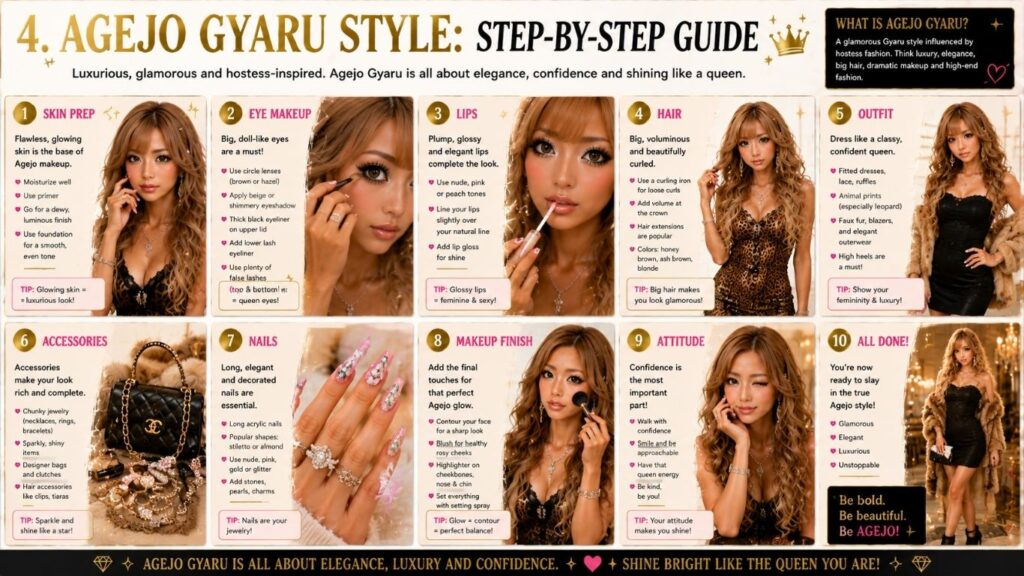
Popular pieces included fitted dresses, lace tops, rhinestone embellishments, faux fur details, and statement accessories. Animal prints, particularly leopard patterns, became closely associated with the style. These elements created an image that was both fashionable and attention-grabbing without crossing into the extreme territory often associated with Ganguro.
Fashion brands such as MA*RS became particularly influential within the Agejo community. Their designs helped define the aesthetic and provided followers with a clear vision of what glamorous Gyaru fashion could look like.
The style’s connection to luxury was not simply about expensive clothing. It was about presenting oneself with confidence and creating a polished appearance that conveyed elegance and self-assurance.
Popular Clothing Styles
Agejo wardrobes often featured clothing designed to emphasize femininity and sophistication. Dresses were among the most popular garments, particularly those featuring fitted silhouettes, lace details, ruffles, and decorative embellishments. These pieces helped create the glamorous appearance that defined the style.
Outerwear also played an important role. Faux fur jackets, tailored coats, and stylish cardigans added texture and visual interest to outfits. High heels were a common choice because they enhanced the overall elegance of the look and complemented the fitted nature of Agejo fashion.
Accessories were carefully selected to reinforce the luxurious image. Sparkling jewelry, embellished handbags, and decorative hair accessories were frequently incorporated into outfits. Rather than relying on excessive layering, Agejo styling focused on coordinating high-impact pieces that worked together harmoniously.
This emphasis on refinement helped distinguish Agejo from other forms of Gyaru and contributed to its enduring popularity among fans of glamorous fashion.
Makeup and Hair Features
Makeup is one of the defining elements of Agejo Gyaru. The style focuses heavily on creating large, doll-like eyes through the use of false lashes, eyeliner, contouring, and carefully blended eye shadow. Unlike Ganguro, which emphasizes dramatic contrast, Agejo makeup aims for glamour and sophistication.
Skin is typically presented as smooth and flawless, with contouring techniques used to enhance facial structure. Glossy lips, highlighted cheekbones, and carefully shaped brows contribute to the polished appearance. Every element is designed to create a luxurious and feminine image.
Hairstyles are equally important. Long curls, voluminous extensions, and perfectly styled bangs became signature features of the aesthetic. Hair colors often included shades of blonde, caramel, and light brown that complemented the overall glamorous presentation.
Together, the makeup and hair create a cohesive look that remains one of the most visually striking interpretations of Gyaru fashion.
Onee Gyaru
What Is Onee Gyaru?
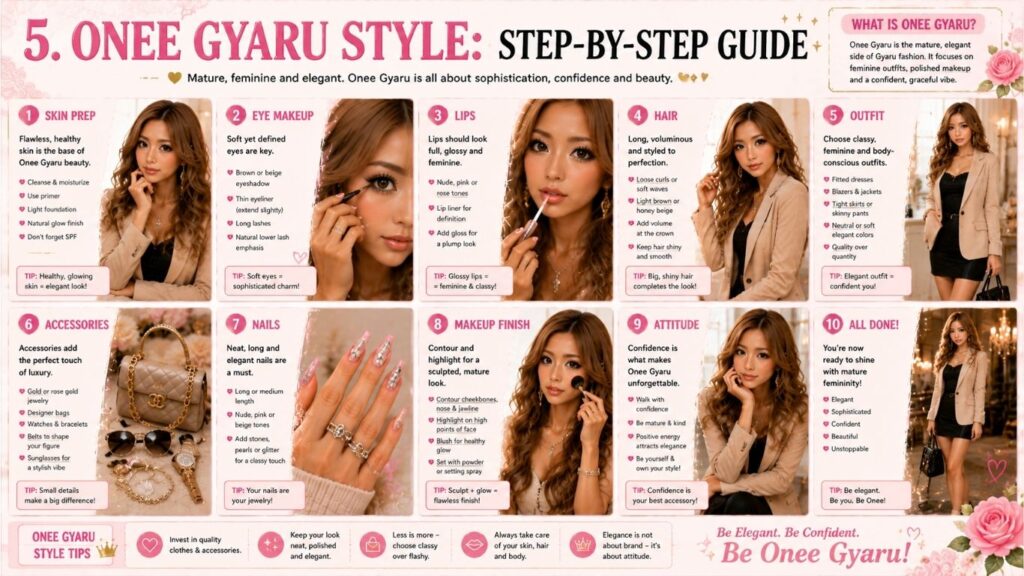
As many early Gyaru enthusiasts grew older, fashion preferences naturally evolved. Onee Gyaru emerged as a mature alternative that allowed women to maintain elements of the Gyaru aesthetic while embracing a more sophisticated lifestyle. The word “Onee” translates roughly to “older sister,” reflecting the style’s elegant and adult-oriented image.
Unlike highly youthful substyles, Onee Gyaru focuses on refinement and versatility. The fashion is designed to be appropriate for a wide range of settings, including professional environments, social gatherings, and everyday activities. This practicality contributed significantly to its popularity among women transitioning into adulthood.
The style retains the confidence and beauty-focused philosophy of Gyaru while presenting it through a more polished lens. As a result, Onee Gyaru became one of the most sustainable and wearable forms of the movement.
Mature Feminine Style
The defining characteristic of Onee Gyaru is its mature femininity. Rather than relying on dramatic visual effects, the style emphasizes flattering silhouettes, coordinated outfits, and understated elegance. Dresses, fitted tops, tailored jackets, and sophisticated accessories form the foundation of the wardrobe.
Color palettes tend to be more neutral than those found in many other Gyaru styles. Beige, black, white, navy, and soft pastel shades are frequently used to create polished looks that feel timeless rather than trend-driven. This restraint helps distinguish Onee Gyaru from more extravagant aesthetics.
Despite its subtlety, the style remains unmistakably fashionable. Every outfit is carefully curated to enhance the wearer’s appearance while maintaining a sense of confidence and individuality. This balance between elegance and self-expression is one of the reasons Onee Gyaru continues to attract followers today.
Wardrobe Essentials
Building a Onee Gyaru wardrobe is less about following strict fashion rules and more about investing in versatile, flattering pieces that create a polished appearance. Unlike more extreme Gyaru styles, which often rely on highly recognizable visual cues, Onee Gyaru focuses on timeless fashion choices that can be incorporated into everyday life. This practical approach is one of the reasons the style continues to resonate with modern fashion enthusiasts.
Essential wardrobe pieces often include fitted dresses, pencil skirts, tailored blazers, elegant blouses, skinny trousers, and sophisticated outerwear. The emphasis is placed on clothing that enhances the body’s natural shape while maintaining an air of refinement. Accessories are carefully chosen rather than excessive, with handbags, jewelry, belts, and heels serving as subtle enhancements rather than focal points.
Many followers appreciate Onee Gyaru because it bridges the gap between street fashion and contemporary women’s fashion. The style allows individuals to maintain a connection to Gyaru culture while adapting to changing professional and social responsibilities. This flexibility has helped Onee Gyaru remain relevant long after many other youth-focused trends faded from popularity.
Rather than chasing every new trend, Onee Gyaru encourages thoughtful styling and confidence, proving that maturity and fashion-forward self-expression can coexist beautifully.
Who Typically Wears Onee Gyaru?
Historically, Onee Gyaru became popular among women who had previously participated in more youthful Gyaru substyles and wanted an aesthetic that reflected their evolving lifestyles. As followers entered adulthood, many sought a look that maintained the glamour and confidence of Gyaru while appearing more sophisticated and versatile.
The style appeals particularly to women who appreciate feminine fashion but prefer elegance over dramatic visual statements. Professionals, fashion enthusiasts, beauty influencers, and individuals interested in Japanese street culture often gravitate toward Onee Gyaru because it balances trend awareness with practicality. Unlike styles that require extensive wardrobe changes, Onee Gyaru can easily be integrated into contemporary fashion.
Modern followers are not limited by age. While the aesthetic was originally associated with adult women, many younger fashion enthusiasts also appreciate its timeless appeal. Social media has further expanded its reach by showcasing how Onee Gyaru can be adapted to different personal styles and lifestyles.
Ultimately, Onee Gyaru attracts individuals who value confidence, sophistication, and self-expression. It demonstrates that Gyaru is not simply a youthful fashion trend but a versatile movement capable of evolving alongside its community.
Himekaji
What Is Himekaji?
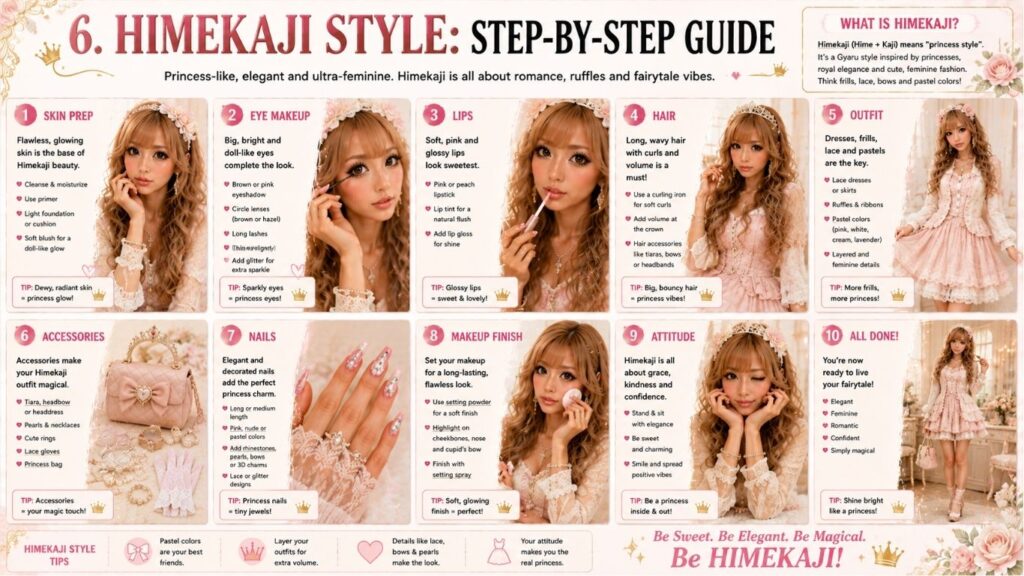
Among all Gyaru substyles, Himekaji stands out for its soft, romantic, and feminine aesthetic. The name combines the Japanese words “Hime,” meaning princess, and “Kaji,” meaning casual. Together, they describe a style that blends fairy-tale elegance with practical everyday fashion. Unlike highly glamorous or rebellious Gyaru styles, Himekaji focuses on creating a sweet and approachable appearance.
The aesthetic emerged as many fashion enthusiasts sought a more wearable alternative to elaborate princess fashion. While traditional princess-inspired styles often involved extravagant dresses and ornate accessories, Himekaji simplified those elements and adapted them for daily life. This made the look more accessible while preserving its romantic charm.
Himekaji quickly gained popularity through fashion magazines and influential brands that promoted feminine silhouettes, delicate patterns, and soft color palettes. The style appealed to individuals who wanted to express elegance without sacrificing comfort or practicality.
Today, Himekaji remains one of the most beloved Gyaru substyles because of its timeless appeal and ability to balance sweetness with sophistication.
Princess Meets Casual Fashion
The defining feature of Himekaji is its ability to combine princess-inspired elements with everyday clothing. Rather than relying on elaborate costumes, the style incorporates subtle details that evoke a romantic and feminine atmosphere. Lace trims, floral prints, ribbons, bows, and soft fabrics frequently appear throughout Himekaji wardrobes.
This balance allows followers to achieve a graceful appearance without appearing overdressed. Cardigans, blouses, skirts, and dresses are often styled together in ways that feel comfortable and approachable. The overall goal is to create an outfit that feels effortlessly elegant while remaining practical enough for daily activities.
Color palettes typically emphasize pastel shades, creams, pinks, and other soft tones that enhance the aesthetic’s gentle personality. Accessories are chosen carefully to complement outfits rather than dominate them. The result is a look that feels cohesive, refined, and distinctly feminine.
Himekaji demonstrates that Gyaru fashion is not limited to bold statements and dramatic transformations. It can also celebrate subtle beauty, romance, and personal charm.
Popular Brands
Fashion brands played a significant role in shaping the identity of Himekaji. Among the most influential was Liz Lisa, whose collections became closely associated with the aesthetic. Known for floral patterns, lace details, and feminine silhouettes, the brand helped define what many people imagine when they think of Himekaji fashion.
Other brands contributed similar influences by emphasizing romantic styling, quality fabrics, and delicate design elements. These companies provided followers with a consistent source of inspiration and helped establish recognizable standards within the community.
The popularity of these brands extended beyond Japan, introducing international audiences to the Himekaji aesthetic. Through online communities and social media, fashion enthusiasts around the world gained access to styling ideas that were once limited primarily to Japanese fashion magazines.
Although trends continue to evolve, the influence of these brands remains visible in modern interpretations of romantic street fashion.
Outfit Examples
A typical Himekaji outfit might feature a floral dress layered with a lightweight cardigan, paired with knee-high socks and delicate accessories. Another common combination includes a lace-trimmed blouse worn with a soft skirt and ballet flats. The emphasis is always on creating a harmonious look that feels feminine and comfortable.
Hairstyles often include loose curls, soft waves, or simple updos accented with bows and ribbons. Makeup tends to be natural and fresh, focusing on glowing skin, rosy cheeks, and subtle eye enhancement. This understated approach complements the clothing without competing for attention.
What makes Himekaji particularly appealing is its versatility. Individual pieces can easily be mixed with contemporary fashion staples, allowing followers to adapt the aesthetic to their personal preferences. This flexibility has helped the style maintain popularity even as broader fashion trends have changed.
For many people, Himekaji serves as an ideal introduction to Gyaru fashion because it offers a gentle and approachable entry point into the culture.
Rokku Gyaru
What Is Rokku Gyaru?
Rokku Gyaru represents the edgy side of the Gyaru spectrum. Inspired by rock music, punk culture, and alternative fashion, the style combines the glamour of traditional Gyaru with a darker, more rebellious attitude. The result is a bold aesthetic that emphasizes confidence, individuality, and self-expression.
Unlike Himekaji’s romantic charm or Onee Gyaru’s sophistication, Rokku Gyaru embraces intensity. The style appeals to individuals who enjoy fashion that makes a strong visual statement while maintaining connections to broader Gyaru culture. Its popularity reflects the movement’s ability to absorb influences from diverse cultural sources and transform them into something uniquely Japanese.
The aesthetic emerged as fashion enthusiasts began incorporating elements of Western rock culture into their wardrobes. Leather jackets, distressed fabrics, and dramatic makeup became central features of the style, creating a look that stood apart from other Gyaru substyles.
Today, Rokku Gyaru remains a favorite among those who appreciate alternative fashion and bold personal expression.
Rock and Punk Influences
Music has always played an important role in shaping fashion movements, and Rokku Gyaru is a perfect example of that relationship. Inspired by rock musicians, punk aesthetics, and alternative subcultures, the style incorporates elements that communicate strength and attitude.
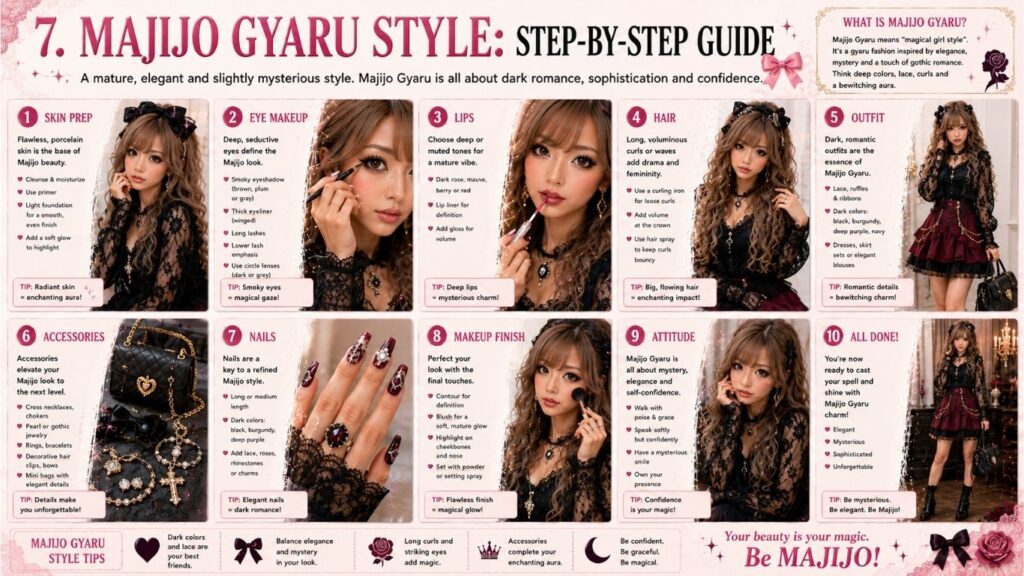
Leather jackets, studded accessories, chains, graphic prints, and dark color palettes are commonly associated with the look. These influences create a visual identity that feels rebellious without abandoning the glamorous aspects of Gyaru fashion. The combination of elegance and edge gives Rokku Gyaru its distinctive appeal.
Western fashion trends also contributed to the development of the style. As Japanese fashion enthusiasts encountered global music and media, they began adapting those influences to fit local tastes. The result was a unique hybrid aesthetic that reflected both international inspiration and Japanese creativity.
This blending of cultural influences demonstrates the adaptability that has always characterized the broader Gyaru movement.
Fashion Staples
Several wardrobe items appear consistently within Rokku Gyaru fashion. Leather jackets are perhaps the most recognizable, often paired with fitted tops, skinny jeans, mini skirts, or distressed shorts. Animal prints, metallic accents, and statement accessories add visual interest while reinforcing the aesthetic’s bold personality.
Footwear frequently includes platform boots, ankle boots, or high heels that complement the strong silhouette of the outfit. Unlike softer Gyaru styles, Rokku Gyaru often prioritizes structure and contrast, creating a more dramatic appearance.
Accessories are used strategically to enhance the overall look. Studded belts, layered necklaces, rings, and bold handbags contribute to the aesthetic without overwhelming it. Each element works together to create an image of confidence and individuality.
These fashion staples allow followers to experiment with different interpretations of the style while maintaining its core identity.
Makeup and Hairstyles
Makeup within Rokku Gyaru emphasizes intensity and drama. Smoky eyes, dark eyeliner, defined lashes, and sculpted facial features are common characteristics. While glamorous, the makeup often incorporates darker tones than those typically seen in other Gyaru substyles.
Hairstyles vary widely but frequently include layered cuts, voluminous styling, or darker hair colors that complement the aesthetic. Some followers prefer dramatic blonde looks, while others choose black or deep brown shades that reinforce the rock-inspired atmosphere.
The goal is to create a cohesive image in which makeup, hair, and clothing support one another. Every detail contributes to the style’s confident and rebellious personality.
Rokku Gyaru demonstrates the incredible range of the Gyaru movement, proving that the culture can accommodate everything from romantic elegance to edgy alternative fashion.
Shiro Gyaru
What Is Shiro Gyaru?
Shiro Gyaru emerged as a softer alternative to some of the more extreme styles within the Gyaru movement. The word “shiro” means white in Japanese, and the aesthetic is often characterized by lighter skin tones, softer makeup, and a cleaner overall appearance. While Ganguro became famous for its dramatic tanning and bold visual contrast, Shiro Gyaru moved in the opposite direction, embracing a fresh and polished interpretation of Gyaru fashion.
Despite these differences, Shiro Gyaru remains firmly connected to the core values of the broader Gyaru movement. Followers still prioritize self-expression, fashionable styling, and carefully curated beauty routines. The style simply achieves these goals through a lighter and more understated aesthetic. This makes it particularly appealing to individuals who appreciate Gyaru culture but prefer a look that can be integrated more easily into everyday life.
The rise of Shiro Gyaru also reflects changing beauty preferences within Japanese fashion. As trends evolved, many enthusiasts began favoring softer makeup techniques and more natural-looking styling while maintaining the confidence and creativity that have always defined Gyaru culture.
Fashion Characteristics
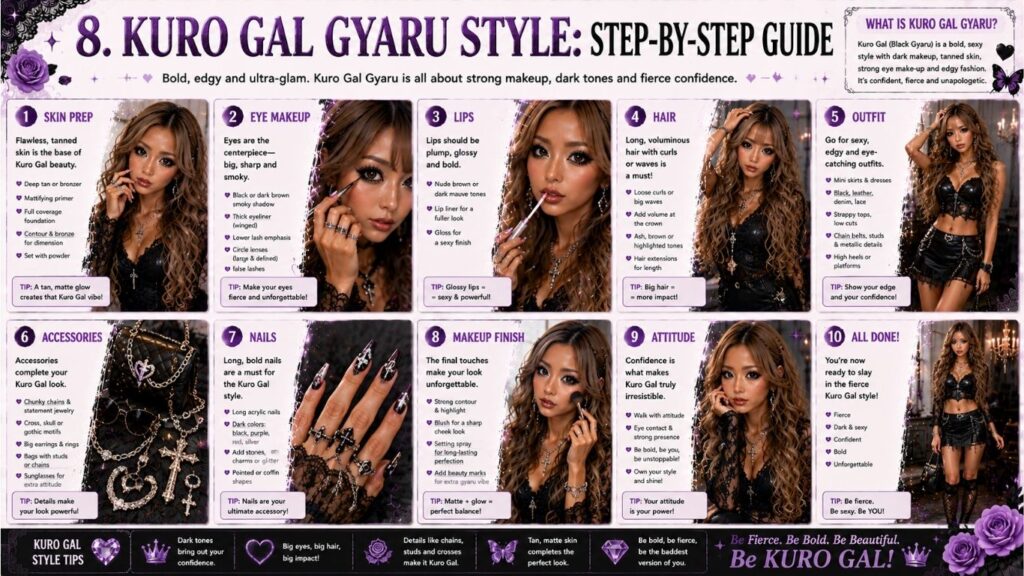
Shiro Gyaru wardrobes often feature light color palettes, elegant silhouettes, and coordinated accessories. White, cream, beige, blush pink, and pastel shades are common choices because they reinforce the clean and feminine appearance associated with the style. Clothing tends to emphasize refinement rather than shock value, creating a polished look that feels modern and wearable.
Unlike more rebellious Gyaru substyles, Shiro Gyaru outfits often focus on balance and harmony. Dresses, skirts, fitted tops, and stylish outerwear are carefully combined to create cohesive ensembles. Accessories remain important but are generally selected to complement outfits rather than dominate them.
The overall aesthetic is sophisticated without becoming overly formal. This versatility allows followers to adapt Shiro Gyaru principles to a wide range of occasions, making it one of the most accessible interpretations of the Gyaru movement.
Beauty Standards
Beauty within Shiro Gyaru centers on achieving a radiant and feminine appearance. Makeup emphasizes smooth skin, bright eyes, soft contouring, and natural-looking enhancement rather than dramatic transformation. False lashes may still be used, but they are typically less exaggerated than those found in styles such as Agejo or Ganguro.
Hair is often styled in soft curls, flowing waves, or polished straight looks. Blonde and light brown shades remain popular, although many followers adapt the aesthetic to suit their natural hair color. The emphasis is on maintaining a well-groomed appearance that complements the overall fashion style.
This approach demonstrates how Gyaru beauty standards evolved over time. While earlier substyles often relied on bold visual contrasts, Shiro Gyaru reflects a shift toward refinement and versatility without abandoning the movement’s emphasis on self-expression.
Why It Emerged
The emergence of Shiro Gyaru was influenced by broader changes within fashion and beauty culture. As trends shifted toward lighter makeup and more natural aesthetics, many Gyaru enthusiasts sought ways to modernize the movement while preserving its identity. Shiro Gyaru provided a solution by combining contemporary beauty preferences with classic Gyaru styling principles.
The style also appealed to individuals who admired the creativity of Gyaru but felt intimidated by more extreme substyles. By offering a softer alternative, Shiro Gyaru helped attract new followers and ensured that the movement could continue evolving alongside changing cultural tastes.
Its success demonstrates one of Gyaru’s greatest strengths: adaptability. Rather than remaining fixed in a single era, the movement has continually reinvented itself in response to new influences and fashion trends.
Shiro Gyaru vs Ganguro
Major Differences
Among all Gyaru comparisons, none is more striking than Shiro Gyaru versus Ganguro. These two styles occupy opposite ends of the aesthetic spectrum, illustrating just how diverse the movement has become. While Ganguro embraces dramatic tanning, bold makeup, and attention-grabbing fashion, Shiro Gyaru focuses on softness, elegance, and refinement.
The contrast extends beyond appearance. Ganguro emerged as a visible rejection of traditional beauty standards, while Shiro Gyaru developed during a period when softer and more natural aesthetics were becoming increasingly popular. Despite these differences, both styles celebrate individuality and encourage followers to express themselves through fashion.
Understanding the relationship between these substyles helps reveal the flexibility of Gyaru culture. Rather than adhering to a single visual formula, the movement allows participants to interpret its values in different ways.
Fashion Comparison
| Feature | Shiro Gyaru | Ganguro |
|---|---|---|
| Color Palette | Light and soft | Bright and bold |
| Clothing Style | Feminine and refined | Playful and dramatic |
| Accessories | Elegant and coordinated | Colorful and eye-catching |
| Overall Appearance | Clean and polished | Rebellious and energetic |
Both styles require attention to detail, but they create very different visual impressions. Shiro Gyaru prioritizes sophistication, while Ganguro embraces maximum visibility.
Makeup Comparison
The makeup differences between these styles are equally significant. Ganguro relies heavily on dark tanning, bright white highlights, dramatic eyeliner, and high-contrast effects. The goal is to create a bold appearance that immediately attracts attention.
Shiro Gyaru, by contrast, focuses on enhancing natural features through softer techniques. Makeup tends to emphasize healthy skin, bright eyes, and balanced facial proportions. While both styles value beauty and self-expression, they achieve those goals through entirely different approaches.
This contrast illustrates how beauty standards within Gyaru have evolved over time, adapting to changing trends while preserving the movement’s creative spirit.
Popularity Comparison
Today, Shiro Gyaru generally enjoys broader mainstream appeal because its aesthetic aligns more closely with contemporary fashion trends. Its versatility allows followers to incorporate elements of the style into everyday wardrobes without making dramatic lifestyle changes.
Ganguro, however, remains one of the most iconic and historically important substyles within the movement. Although fewer people wear it today, its influence continues to be celebrated by fashion enthusiasts, historians, and members of the Gyaru community.
Together, these styles represent different eras and philosophies within Gyaru fashion, demonstrating the movement’s remarkable range and adaptability.
Lesser-Known Gyaru Styles
Hime Gyaru
Hime Gyaru takes the princess-inspired elements of Japanese fashion to an extreme level. Luxurious dresses, ornate accessories, elaborate hairstyles, and elegant makeup define the style. Followers often create highly coordinated outfits that resemble modern fairy-tale interpretations while maintaining core Gyaru beauty principles.
Goshikku Gyaru
Goshikku Gyaru combines Gothic fashion with traditional Gyaru aesthetics. Dark clothing, lace details, dramatic makeup, and sophisticated accessories create a unique look that blends elegance with mystery. The style appeals to individuals who enjoy alternative fashion while remaining connected to Gyaru culture.
Amekaji Gyaru
Inspired by American casual fashion, Amekaji Gyaru emphasizes denim, relaxed silhouettes, and comfortable styling. The aesthetic demonstrates how international influences have shaped the evolution of Japanese street fashion over time.
Tsuyome Gyaru
Tsuyome Gyaru focuses on strong, confident styling. Bold makeup, animal prints, fitted clothing, and glamorous accessories create a powerful visual identity that stands out within the broader Gyaru community.
Neo Gyaru
Neo Gyaru represents the modern evolution of the movement. Rather than following strict historical rules, followers combine classic Gyaru elements with contemporary fashion trends, creating fresh interpretations that resonate with younger audiences.
Which Type of Gyaru Is Best for Beginners?
Easiest Styles to Start With
For beginners, Onee Gyaru, Himekaji, and Shiro Gyaru are generally the easiest entry points into the culture. These styles rely on wearable fashion choices that can be incorporated into existing wardrobes without requiring dramatic changes. They also emphasize styling techniques that are easier to learn than the more complex makeup routines associated with Ganguro or Agejo.
Starting with a softer style allows newcomers to become familiar with Gyaru aesthetics while gradually building confidence. Over time, they can experiment with additional elements and explore other substyles that align with their personal preferences.
Budget-Friendly Options
One common misconception is that participating in Gyaru fashion requires expensive clothing and accessories. While certain styles may involve luxury brands, many Gyaru-inspired outfits can be created using affordable pieces sourced from local retailers or online shops.
Building a wardrobe gradually is often the most practical approach. Investing in versatile items such as skirts, dresses, cardigans, and accessories provides flexibility while reducing costs. Creativity and styling skills frequently matter more than the price of individual garments.
Modern Styles Suitable for Daily Wear
Modern interpretations of Onee Gyaru and Shiro Gyaru are particularly well suited for everyday life. Their emphasis on polished fashion and adaptable beauty routines makes them compatible with work, school, social events, and casual outings.
This practicality helps explain why these styles continue to attract new followers. They preserve the spirit of Gyaru while fitting comfortably into contemporary lifestyles.
Is Gyaru Still Popular Today?
Modern Gyaru Communities
Although Gyaru is no longer the dominant force it once was, the community remains active both in Japan and internationally. Online forums, social media groups, and fashion events provide opportunities for enthusiasts to share inspiration, discuss trends, and celebrate the movement’s history.
These communities play an important role in preserving knowledge about historical substyles while encouraging new interpretations. Through collaboration and creativity, they ensure that Gyaru remains a living fashion culture rather than a historical curiosity.
Social Media Revival
Platforms such as TikTok, Instagram, and YouTube have contributed significantly to the revival of Gyaru fashion. Tutorials, styling videos, and transformation content regularly introduce new audiences to the movement, helping generate interest among younger generations.
This digital exposure has also made it easier for international followers to access information and participate in the community. As a result, Gyaru’s influence now extends far beyond Japan.
Global Influence
Today, Gyaru can be found in fashion communities across North America, Europe, Southeast Asia, and other regions. Its emphasis on self-expression resonates with individuals who appreciate alternative fashion and creative styling.
The movement’s global reach demonstrates its enduring relevance and highlights the universal appeal of its core values.
How Gyaru Influenced Modern Fashion
Influence on Beauty Trends
Many beauty techniques that are now widely accepted were popularized within Gyaru culture years earlier. False lashes, contouring, circle lenses, and dramatic eye makeup all gained visibility through the movement before becoming mainstream beauty trends.
Influence on Anime and Pop Culture
Gyaru aesthetics continue to appear in anime, manga, and video games. These representations introduce the style to new audiences and help preserve its cultural significance. Many popular characters draw inspiration from classic Gyaru fashion elements.
Influence on Contemporary Fashion
Modern fashion’s emphasis on personal aesthetics and self-expression shares clear similarities with the philosophy that helped Gyaru thrive. The movement demonstrated that fashion could serve as a powerful tool for identity and individuality.
Common Misconceptions About Gyaru
Gyaru Is Not One Single Style
Perhaps the biggest misconception is that Gyaru refers exclusively to Ganguro. In reality, the movement contains numerous substyles ranging from romantic and feminine to glamorous and rebellious.
Gyaru Is More Than Makeup
While makeup is important, Gyaru also encompasses fashion, lifestyle, community, and cultural identity. Focusing solely on cosmetics overlooks much of what makes the movement meaningful.
Gyaru Never Truly Disappeared
Although its visibility has fluctuated over time, Gyaru continues to evolve through modern communities and online platforms. The movement remains influential despite changing fashion trends.
Conclusion
The world of Gyaru fashion is far richer and more diverse than many people realize. From the bold rebellion of Ganguro and the youthful energy of Kogal to the elegance of Agejo, Onee Gyaru, and Himekaji, each substyle tells a unique story about creativity, identity, and self-expression. Together, these aesthetics demonstrate how a single fashion movement can evolve into a collection of distinct yet interconnected communities.
One of the greatest strengths of Gyaru is its adaptability. Over the decades, it has absorbed influences from luxury fashion, rock music, princess aesthetics, Western streetwear, and contemporary beauty trends while maintaining its core values of confidence and individuality. This ability to evolve has allowed the movement to remain relevant long after many other fashion trends disappeared.
Whether you’re interested in exploring Japanese street fashion, finding a new personal aesthetic, or learning about one of the most influential youth cultures in modern Japan, understanding the different types of Gyaru provides valuable insight into a fascinating fashion phenomenon.
The best way to continue your journey is to explore individual substyles in greater detail. Dive deeper into Ganguro, Kogal, Agejo Gyaru, Onee Gyaru, Himekaji, and Rokku Gyaru to discover which aesthetic resonates most with your personality and fashion goals. The diversity of Gyaru ensures that there is a style for nearly everyone willing to embrace creativity and self-expression.