


Business Casual Dresses Most people don’t struggle with finding dresses—they struggle with finding the right dresses for work. Something can look great on a hanger and still feel slightly “off” in an office setting. Too short, too loud, too relaxed, or just not quite polished enough. That gap between stylish and professional is exactly where business casual dresses sit.
In modern workplaces across the USA, dress codes have become more flexible, but expectations haven’t disappeared. A business casual dress still needs structure, balance, and a sense of intention. It should look easy, but not careless. The best ones work across meetings, desk days, and even after-work plans without needing a full outfit change.
Understanding how to choose, style, and adapt office dresses seasonally makes dressing for work far less stressful. Once you see the patterns—fabric choices, silhouettes, layering tricks—it becomes much easier to build outfits that consistently feel appropriate and confident without overthinking it every morning.
What Actually Counts as a Business Casual Dress?
Business Casual Dresses If you asked ten office workers to define business casual dresses, you’d probably get ten slightly different answers. That’s because the category isn’t rigid anymore. It’s more about balance than strict rules.
A business casual dress usually sits between formal office wear and everyday casual clothing. Think structured but comfortable. Clean lines rather than overly decorative designs. A midi sheath dress in navy or black fits easily into most offices. A soft wrap dress in a muted print also works, as long as the fit isn’t too revealing and the fabric feels intentional rather than beachy or lounge-like.
Where people usually go wrong is assuming “casual” means anything goes. A sundress with thin straps might be fine for brunch but feels underdressed in a client meeting. On the other hand, a sharply tailored midi dress with minimal detailing can look polished even in conservative environments. Brands like Ann Taylor, Banana Republic, and J.Crew built entire reputations on hitting that middle ground.
The Rules Nobody Writes Down (But Everyone Notices)

Business Casual Dresses Office dress codes often aren’t spoken—they’re observed. You learn quickly by watching what others wear and adjusting accordingly. Still, there are a few unspoken rules that consistently apply across industries.
Length matters more than most people think. Knee-length or midi dresses are the safest choices. Shorter dresses can work, but they usually need tighter styling control—think higher necklines or structured fabrics. Neckline balance also plays a role. If a dress has a deeper V-neck, it should be offset with sleeves or layering.
Fabric is another quiet signal. Ponte knit, crepe, cotton blends, and lightweight wool blends tend to read as professional because they hold shape. Something too thin or too shiny often feels more casual than intended, even if the design looks fine.
There’s also a subtle workplace logic around prints. Loud patterns aren’t automatically wrong, but they do shift attention. In more conservative industries like finance or law, solid colours usually feel safer. Creative workplaces allow more flexibility, but even there, “intentional” styling matters more than trend-chasing.
The Dress Styles That Consistently Work in Offices
Business Casual Dresses Not every dress style belongs in a business casual wardrobe, but a few silhouettes almost always perform well. The sheath dress is probably the most reliable option—it follows the body without clinging, and it looks structured even without heavy styling. It’s the kind of piece that works equally well under a blazer or on its own.
Wrap dresses are another strong choice because they naturally adjust to different body shapes. A knee-length wrap dress in a matte fabric can move easily from internal meetings to client presentations without feeling overdressed or underprepared.
Business Casual Dresses Midi dresses have become especially popular in hybrid workplaces. They strike a balance between comfort and professionalism, and they work across seasons with minimal adjustments. Shift dresses and shirt dresses also deserve attention, especially when paired with a belt or structured outer layer to avoid a boxy silhouette.
One thing experienced professionals notice over time: versatility matters more than trendiness. A simple dress that works five different ways is far more valuable than a statement piece worn once a month.
Styling Office Dresses Without Overthinking It
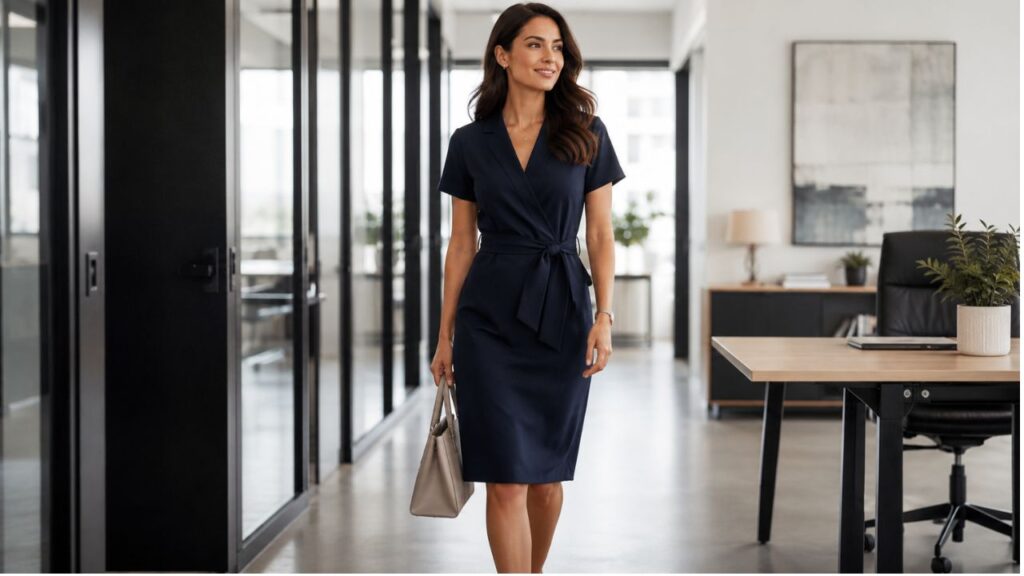
Styling is where most business casual outfits either come together or fall apart. A good dress can still look wrong if everything around it feels disconnected. The easiest way to approach it is to think in layers rather than individual items.
A structured blazer instantly elevates almost any office dress. It signals professionalism without needing extra effort. In colder months, a tailored coat or longline cardigan can do the same job while keeping the outfit functional. The key is proportion—oversized layers can work, but only when the dress underneath still feels defined.
Business Casual Dresses Shoes also quietly shape perception. Pumps remain the most universally accepted option, but loafers and block heels have become just as common in modern offices. Ballet flats work well in more relaxed environments, especially when paired with a structured dress. Sneakers are still situational—they can work in tech or creative spaces, but rarely in client-facing roles.
Accessories should support the outfit, not compete with it. A simple watch, a structured tote bag, and minimal jewellery usually complete the look without overcomplicating it.
Seasonal Dressing: What Actually Changes
Seasonal styling in business casual wear is less about reinventing your wardrobe and more about adjusting materials and layering.
In summer, breathable fabrics like cotton blends and lightweight crepe make the biggest difference. Sleeveless dresses can work, but they usually pair better with a light blazer or cardigan for office environments. In winter, sweater dresses and wool blends take over, often paired with tights and boots for practicality as much as style.
Spring and autumn are transitional seasons where layering becomes the main tool. A midi dress with a trench coat, or a shirt dress with ankle boots, fits comfortably into most office environments without feeling weather-inappropriate.
Business Casual Dresses One detail professionals often overlook is temperature inconsistency indoors. Offices can be freezing in summer and overheated in winter, which makes layering pieces like cardigans and blazers more practical than seasonal extremes.
Building a Wardrobe That Doesn’t Feel Repetitive
A strong business casual wardrobe doesn’t need dozens of dresses. It needs the right ones. Most professionals find that five to seven well-chosen dresses can cover nearly every work situation when styled properly.
Business Casual Dresses A typical foundation might include a black sheath dress, a neutral wrap dress, a midi dress in a muted tone, a shirt dress for relaxed days, and a sweater dress for colder months. These pieces can rotate with different shoes and layers without feeling repetitive.
This is where capsule thinking becomes useful. Instead of buying for individual occasions, you’re building combinations. A single blazer can change the tone of multiple dresses. A pair of loafers can shift an outfit from formal to relaxed without replacing the core piece.
Over time, people tend to realise that consistency beats variety. A smaller, well-structured wardrobe often looks more polished than a large, inconsistent one.
Common Mistakes That Quietly Ruin an Outfit

Most business casual mistakes aren’t dramatic—they’re subtle. The dress itself might be fine, but something small throws the balance off.
Business Casual Dresses One common issue is fit. Even a good-quality dress looks unprofessional if it doesn’t sit properly on the shoulders or waist. Another is fabric choice. Stretchy, overly thin materials can unintentionally read as loungewear, even in structured designs.
Over-accessorising is another frequent problem. Too many statement pieces compete with the simplicity that business casual style relies on. On the other end, under-styling can make an outfit feel unfinished, especially in more formal workplaces.
There’s also a tendency to ignore context. What works in a startup environment may feel too relaxed in a corporate office. Reading the room still matters more than following generic rules.
FAQ
What is considered a business casual dress?
A business casual dress is typically a knee-length or midi dress with a structured, modest design suitable for office environments. It avoids overly casual fabrics and balances comfort with professionalism.
Can you wear sleeveless dresses in business casual offices?
Yes, but it depends on the workplace. In most cases, sleeveless dresses are better paired with a blazer or cardigan to maintain a polished appearance.
Are floral dresses appropriate for the office?
They can be, as long as the print is subtle and the overall silhouette remains structured. Large, bold prints are usually better suited to creative workplaces.
What shoes work best with office dresses?
Pumps, loafers, and block heels are the most versatile options. Flats can work in relaxed environments, while sneakers depend heavily on company culture.
How many business casual dresses should you own?
Most professionals find five to seven versatile dresses enough when combined with layering pieces and accessories.
Conclusion
Business casual dresses aren’t about strict rules anymore—they’re about understanding balance. The right dress doesn’t demand attention, but it doesn’t disappear either. It sits comfortably in that middle space where you look appropriate for the room without feeling restricted by it.
Once you start noticing how fabric, structure, and layering influence perception, getting dressed becomes less about guessing and more about choosing. And that’s usually when office style starts feeling easier, not harder.