

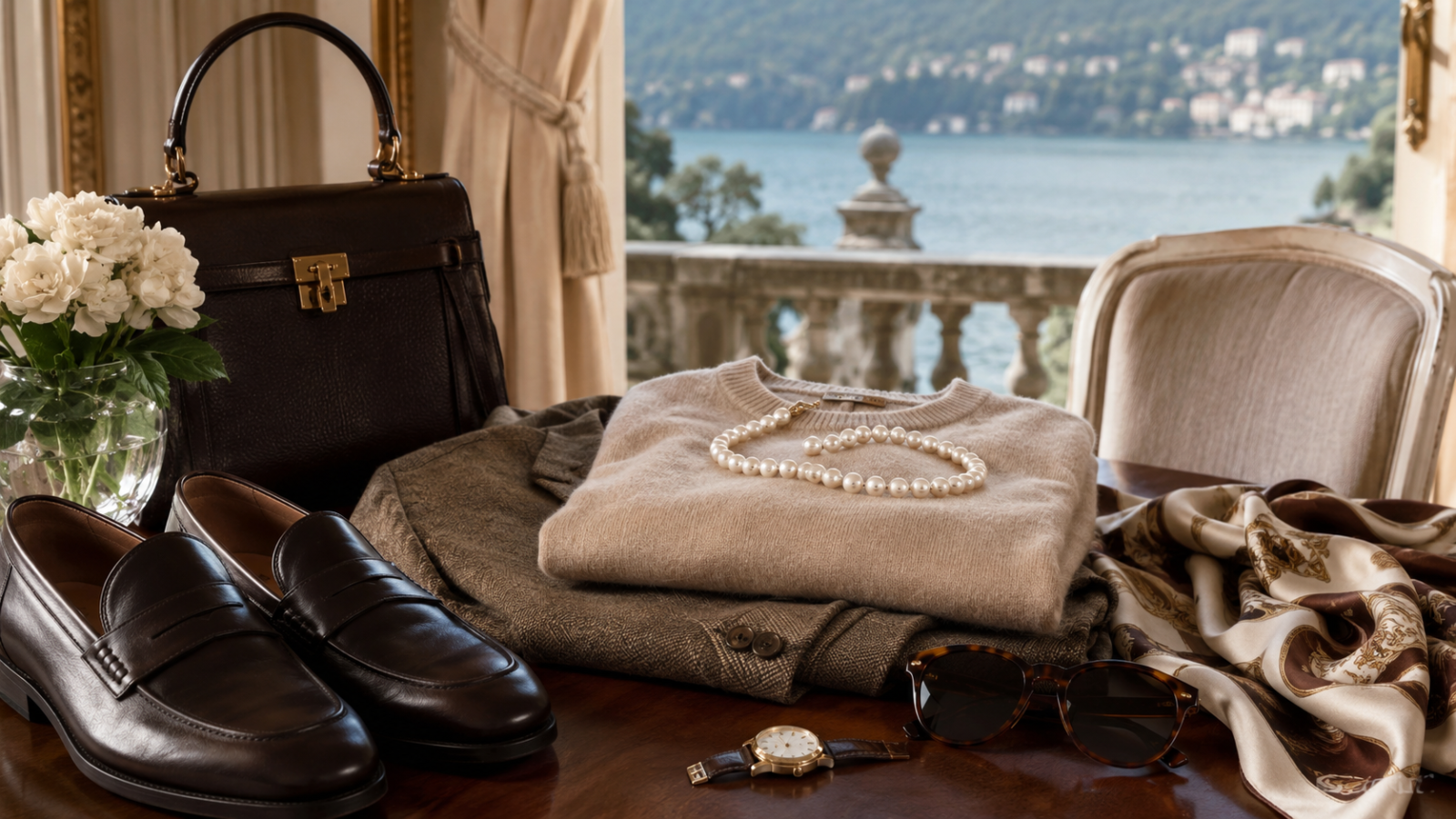
Old Money Style isn’t really about clothes at all. It’s more about restraint—what you choose not to wear matters just as much as what you do. If you look closely at the people this aesthetic is based on, you’ll notice they rarely try to stand out in an obvious way. There’s no obsession with seasonal trends, no loud branding, and no need to prove anything through outfits.
In the USA, the style has become popular again through social media, but most online versions miss the point. It’s not about copying a “rich” look. It’s about understanding consistency, fit, and materials that hold up over time. Think tailored jackets that quietly sit right on the shoulders, shoes that don’t scream for attention, and clothing that feels normal rather than styled for attention. Once you understand that mindset, the whole aesthetic becomes easier to grasp.
Old Money Style Is More About Discipline Than Fashion
If you ask a fashion expert what separates Old Money Style from modern aesthetics, they won’t start with brands. They’ll talk about discipline. The kind of wardrobe built slowly, with intention, where every piece has a reason to exist. Nothing is random. Nothing is bought just because it’s trending.
In real life, this often shows up as repetition. The same navy blazer worn for years. The same loafers polished instead of replaced. The same neutral tones that make getting dressed almost automatic. It’s less about creativity in the loud sense and more about removing decision fatigue. People often assume this look is expensive, but the real marker is consistency, not price tags.
There’s also a subtle psychological angle here. Old Money fashion avoids attention-seeking signals. Logos are minimal or absent. Silhouettes are structured but not tight. Even grooming follows the same logic—clean, controlled, and understated rather than experimental.
The Foundation: Fabrics, Fit, and Silence in Design
One thing that rarely gets explained properly online is how much fabric choice matters. In Old Money fashion, material does most of the talking. A simple cotton shirt can look expensive if the weave is dense and the cut is clean. The same goes for wool, cashmere, linen, and tweed. These fabrics don’t just look better—they age better.
Fit is the second layer, and this is where most people go wrong when trying to recreate the aesthetic. It’s not about slim or oversized extremes. It’s about natural structure. Shoulders should sit where your body naturally ends. Trousers should fall cleanly without stacking awkwardly. Even casual pieces like polo shirts or knitwear follow the same rule: nothing should look accidental.
Design silence is the third element. Old Money Style avoids visual noise. No heavy graphics. No exaggerated stitching. No unnecessary detail that draws the eye for the wrong reason. If a piece is well-made, it doesn’t need decoration to prove it.
A quiet observation from stylists is that people often overestimate the role of “luxury brands” here. In reality, a well-fitted, mid-range blazer often looks closer to the aesthetic than an expensive but poorly tailored designer piece.
Building the Wardrobe: Not a Collection, But a System
A lot of fashion advice treats wardrobes like collections. Old Money Style works more like a system. Each item is expected to work with several others, and there’s very little room for single-use pieces.
A typical foundation revolves around a few categories: structured outerwear, simple knitwear, neutral trousers, and clean footwear. You’ll often see pieces like navy blazers, white oxford shirts, beige chinos, wool coats, and loafers forming the backbone. These aren’t random picks—they’re chosen because they interact well across settings.
What’s often missing from beginner attempts is repetition. People try to build variety too quickly, when the real aesthetic comes from controlled limitation. Wearing variations of the same silhouette actually strengthens the look rather than weakening it.
For example, swapping a blazer for a wool coat doesn’t change the identity of the outfit—it just adjusts it for weather. That’s the level of simplicity the style leans toward. You’re not reinventing yourself every day; you’re refining a consistent visual language.
Men’s Old Money Style: Quiet Structure Over Trend Cycles
Men’s Old Money Style has strong roots in Ivy League dressing, and you can still see that influence today in American fashion. The core idea is controlled structure without aggression. A good blazer isn’t tight, but it isn’t baggy either. Shirts are crisp without looking stiff. Trousers fall cleanly without shouting for attention.
A man dressed in this style usually doesn’t look like he’s trying to be fashionable. That’s the point. The outfit feels like it has been the same for years, even if it hasn’t. Loafers, Oxford shirts, neutral sweaters, and tailored trousers make up most of the rotation.
Grooming matters more than people expect. Haircuts are simple and maintained regularly. Facial hair, if present, is controlled rather than styled dramatically. Even fragrance choices tend to be subtle instead of overpowering.
One overlooked detail is how often men in this aesthetic repeat outfits without apology. In modern fashion culture, repetition is often seen as boring, but here it signals stability and confidence.
Women’s Old Money Style: Soft Structure Without Over-Styling
For women, Old Money Style tends to balance structure with softness. It avoids extremes—nothing overly edgy, nothing overly delicate. The silhouettes are elegant but practical, and there’s a strong emphasis on natural appearance rather than heavy styling.
Outfits often revolve around knitwear, tailored trousers, midi skirts, and simple blouses. A common combination is a neutral blazer over a silk or cotton top paired with well-fitted trousers. Dresses, when used, are usually understated and rely on fabric and cut rather than decoration.
Accessories are minimal but intentional. A single pair of gold earrings, a leather handbag without loud branding, or a simple watch can complete an outfit without overwhelming it. Hairstyles also play a role here—clean buns, soft waves, or natural textures tend to fit better than overly structured styling.
Makeup follows the same philosophy. It enhances rather than transforms. Skin-focused looks with neutral tones are more aligned with the aesthetic than heavy contouring or bold color experiments.
The Quiet Luxury Overlap (and Where People Get Confused)
Old Money Style often gets mixed up with Quiet Luxury, and while they overlap, they aren’t identical. Quiet Luxury is more about modern minimalism in high-end fashion. Old Money Style is more rooted in tradition and inherited taste.
Quiet Luxury can feel newer, cleaner, and more brand-driven in subtle ways. Old Money Style feels older, more lived-in, and less concerned with appearing current. One is influenced by fashion cycles; the other tries to ignore them entirely.
A simple way to separate them is this: Quiet Luxury still participates in fashion trends, just quietly. Old Money Style tries to step outside of them as much as possible.
That difference is small but important. It changes how outfits are built, how pieces are selected, and even how long clothing stays in rotation.
Budget Reality: You Don’t Need Wealth, But You Do Need Patience
There’s a misconception that Old Money Style requires expensive wardrobes. In reality, the barrier is more about patience than money. The aesthetic depends heavily on selection rather than quantity.
A well-chosen blazer from a mid-range brand can look more authentic than a high-end piece with poor fit. The same applies to shoes—clean, simple leather loafers often outperform flashy alternatives regardless of price.
Thrift stores and vintage shops actually fit surprisingly well into this style, especially in the USA, where older tailoring standards were often higher. The key is to focus on condition and fabric quality rather than labels.
Where people usually go wrong is rushing the process. Old Money Style isn’t built in a weekend. It develops as you replace weak pieces slowly and upgrade only when necessary.
Common Mistakes That Break the Aesthetic Immediately
One of the biggest mistakes is over-styling. The moment an outfit looks “constructed,” it starts to lose the Old Money feel. This includes too many accessories, overly trendy shoes, or mixing conflicting styles.
Another issue is fabric mismatch. A cheap-looking synthetic fabric can ruin an otherwise good outfit instantly. The aesthetic depends heavily on tactile quality, even if it isn’t obvious at first glance.
The third mistake is trying to look rich instead of looking consistent. These are very different goals. Old Money Style doesn’t try to signal wealth directly—it signals stability, simplicity, and familiarity.
FAQ
What is Old Money Style really about?
It’s a fashion approach focused on timeless, understated clothing built around quality fabrics, clean fit, and minimal branding rather than trends.
Can you achieve Old Money Style on a budget?
Yes, but it requires careful selection. Focus on fit and fabric rather than labels, and build slowly instead of buying in bulk.
Is Old Money Style the same as Quiet Luxury?
They overlap, but Old Money Style is more traditional and less trend-influenced, while Quiet Luxury is more modern and brand-adjacent.
What are the key clothing pieces?
Blazers, knitwear, tailored trousers, loafers, trench coats, and neutral shirts form the foundation.
Conclusion
Old Money Style works best when it stops feeling like a “style” you’re actively trying to perform. The more natural it becomes in your choices, the closer it gets to the real thing. It’s less about transformation and more about reduction—removing excess until only what works remains. Once that shift happens, getting dressed becomes simpler, and the results look more consistent without effort.