

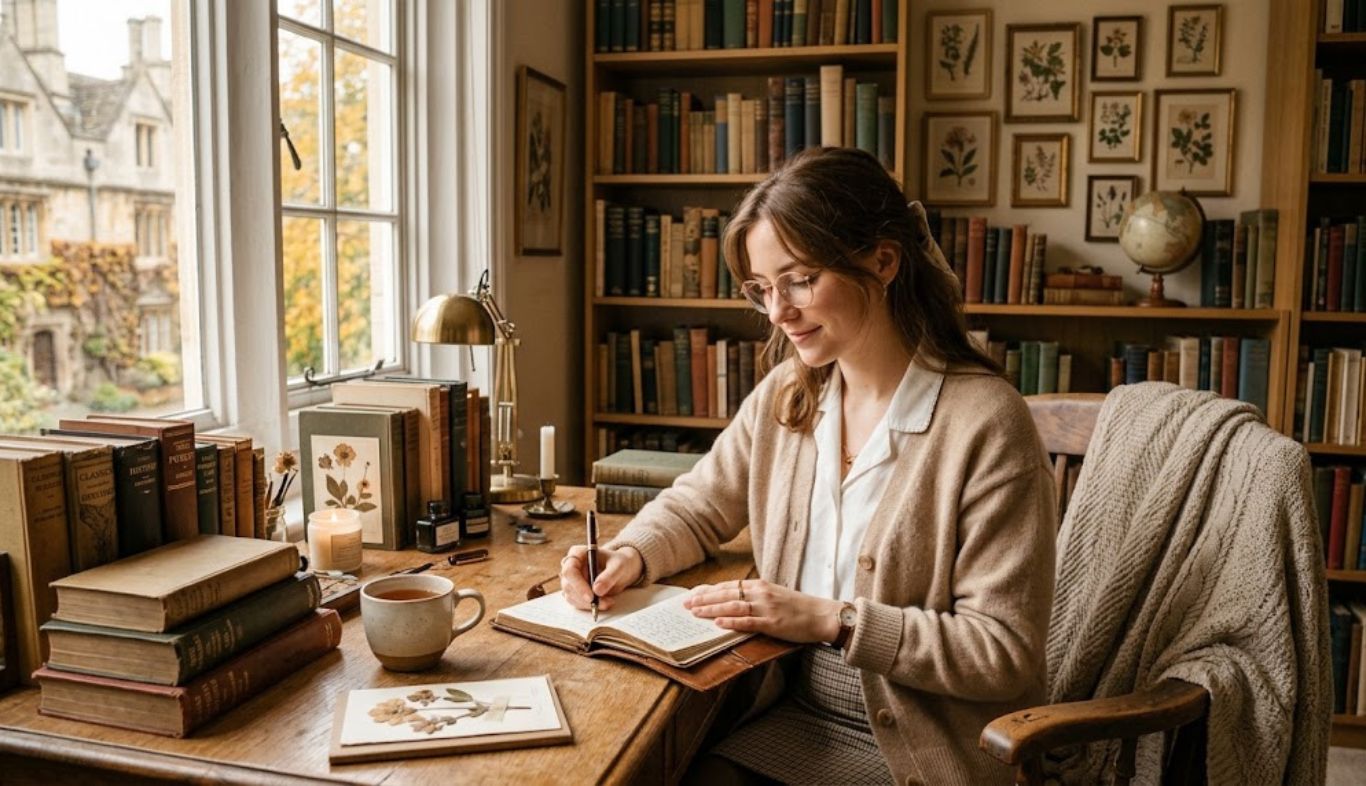
The Light Academia Lifestyle is more than an attractive collection of beige sweaters, old books, coffee cups, and sunlit study desks. At its heart, it’s a way of living that celebrates learning, creativity, beauty, curiosity, reflection, and intentionality. The aesthetic is often associated with warm neutrals, natural light, classic literature, handwritten notes, museums, historic architecture, classical music, art, and comfortable clothing. However, its deeper appeal comes from something much simpler: it encourages you to slow down and become interested in the world around you.
You might spend an afternoon reading a novel, sketching in a notebook, visiting a museum, learning a language, writing a thoughtful letter, or taking a quiet walk while listening to music. None of these activities requires a wealthy lifestyle. In fact, many of them cost little or nothing. That accessibility is important. A genuine Light Academia Lifestyle shouldn’t feel like a performance for social media. It should feel like your real life, only more deliberate.
The aesthetic also has roots in older ideas about scholarship and culture. Libraries, universities, literary societies, studios, museums, and traditional crafts all provide visual inspiration. The British Library, for example, describes its Reading Rooms as quiet spaces designed for accessing collections and personal study, demonstrating how physical environments can encourage concentration and learning. Likewise, the Victoria and Albert Museum maintains extensive collections covering fine and decorative arts, books, fashion, furniture, craft, and design. Its National Art Library offers a particularly rich example of how books and visual culture can become part of an inspiring intellectual environment.
So, rather than asking, “How can I look like this aesthetic?” ask a better question:
“How can I make my everyday life more curious, creative, peaceful, and meaningful?” That’s where the transformation begins.
1. Understand the Core Philosophy
Before buying anything, understand the principles behind the Light Academia Lifestyle.
The most important values are:
- Curiosity
- Lifelong learning
- Creativity
- Appreciation of art
- Reading
- Reflection
- Simplicity
- Personal expression
- Connection with nature
- Intentional living
These values matter more than specific colors or clothing. For example, you don’t need a vintage desk to become more interested in history. You can read a biography at an ordinary kitchen table. You don’t need an antique typewriter to become a writer. A basic notebook works perfectly well. The visual style is simply a tool for creating an environment that supports these habits.
Light Academia vs. Dark Academia
Although the two aesthetics share an interest in learning, books, history, and traditional academic environments, they have different moods.
| Light Academia | Dark Academia |
|---|---|
| Cream, ivory, beige, soft brown | Black, charcoal, burgundy, deep green |
| Natural sunlight | Moody lighting |
| Optimistic | Dramatic or melancholic |
| Linen and cotton | Tweed, wool, leather |
| Gardens and bright rooms | Old libraries and shadowy interiors |
| Gentle romanticism | Gothic and mysterious influences |
| Creativity and warmth | Mystery and intellectual intensity |
Neither style is “better.” You can also combine elements from both. The important thing is choosing an atmosphere that makes you feel comfortable and inspired.
2. Build a Curious Mindset

A beautiful room won’t create an academic lifestyle if your mind has nothing to explore. The foundation of the Light Academia Lifestyle is curiosity.
Start by choosing subjects you genuinely want to understand. You could explore architecture, poetry, psychology, philosophy, astronomy, art history, gardening, music, languages, or local history. Don’t worry about becoming an expert immediately.
Instead, use a simple learning cycle:
- Choose a subject.
- Read an introductory book or reliable article.
- Take handwritten notes.
- Write down questions.
- Explore related topics.
- Discuss what you’ve learned.
- Return to the subject later.
This approach turns learning into an ongoing conversation rather than a school assignment.
Create a Personal Reading List
Your reading list can contain several categories:
- One classic novel
- One modern novel
- One biography
- One history book
- One poetry collection
- One book about art or design
- One practical nonfiction book
You don’t need to read all seven simultaneously. In fact, reading slowly can be more rewarding. Keep a notebook nearby and record memorable ideas, unfamiliar words, questions, and personal reactions. The goal isn’t to finish books as quickly as possible. The goal is to allow books to change how you think.
3. Design a Light, Comfortable Home
Your surroundings strongly influence your habits. Fortunately, creating a Light Academia Lifestyle at home doesn’t require a complete interior makeover. Focus on light, texture, books, and personality.
Choose a Soft Color Palette
Start with colors such as:
- Warm white
- Cream
- Ivory
- Oatmeal
- Taupe
- Soft brown
- Muted sage
- Dusty blue
- Pale yellow
You don’t need every item to match. A home becomes more interesting when different textures and tones work together.
Prioritize Natural Light
Natural light is one of the easiest ways to create the desired atmosphere. Keep windows relatively clear during the day. Use lightweight curtains where practical, and place a reading chair or desk near a bright window. If your room is naturally dark, don’t worry. Use warm lamps rather than trying to imitate sunlight perfectly. The goal is comfort, not perfection.
Add Books With Purpose
Books are central to the aesthetic, but they shouldn’t become meaningless decoration. Keep books you genuinely enjoy or want to read. A small shelf of carefully selected books can look more personal than a huge shelf filled only for appearance.
You can also display:
- Poetry collections
- Sketchbooks
- Art books
- Travel journals
- Old family photographs
- Postcards
- Botanical prints
- Handwritten notes
The V&A’s collections demonstrate just how rich the relationship between books, typography, craft, and visual design can be. Its material on William Morris, for instance, shows how seriously he treated typefaces, spacing, borders, illustrations, and the physical beauty of books.
Choose Useful Vintage-Inspired Pieces
Instead of purchasing lots of decorative objects, select a few functional pieces:
- Wooden desk
- Brass lamp
- Ceramic mug
- Linen cushion
- Woven basket
- Framed print
- Simple clock
- Wooden bookcase
A secondhand shop or family home may already contain everything you need.
4. Create an Inspiring Study Space
You don’t need an enormous library to build an academic corner. Even a small desk can become a dedicated place for reading, studying, journaling, or creative work.
Keep the surface relatively clear. A practical setup might include:
- Notebook
- Pens or pencils
- Reading book
- Desk lamp
- Water bottle
- Small plant
- Calendar
- One meaningful object
Avoid filling the desk with unnecessary decorations. Your study area should communicate one simple message:
This is where I come to think.
If you enjoy libraries, occasionally work from one. The British Library, for example, provides public study desks and Reading Rooms, illustrating how a dedicated environment can help separate focused work from everyday distractions.
5. Develop a Classic, Comfortable Wardrobe
Fashion is another visible part of the Light Academia Lifestyle, but you don’t need to replace your entire closet. Instead, build outfits around classic shapes and natural-looking colors.
Essential Clothing Pieces
Consider:
- Cream knit sweaters
- White or pale-blue shirts
- Straight-leg trousers
- Pleated skirts
- Linen trousers
- Cardigans
- Simple blazers
- Loafers
- Ballet flats
- Oxford-style shoes
- Neutral coats
- Lightweight scarves
The key is versatility. A cream cardigan can work with jeans, trousers, a skirt, or a simple dress. A white shirt can become casual or formal depending on the styling.
Focus on Fabric and Fit
Color isn’t everything. Look for comfortable fabrics such as cotton, linen, wool, corduroy, and soft knits when they’re appropriate for your climate. Good fit also matters more than brand names. A simple outfit that fits well will generally look more polished than an expensive outfit that doesn’t suit you.
Don’t become trapped by an aesthetic uniform.
Add Personal Details
You can include:
- Jewelry with sentimental value
- A colorful scarf
- Vintage accessories
- Cultural clothing
- Favorite sneakers
- Handmade pieces
- Family heirlooms
Personal style should remain personal.
6. Create Meaningful Morning Rituals
A Light Academia Lifestyle works best when it becomes a collection of small habits. Your morning doesn’t need to resemble a movie scene.
Try a realistic routine:
- Open the curtains.
- Drink water.
- Make your bed.
- Spend five minutes stretching.
- Read a few pages.
- Write three priorities.
- Have breakfast without scrolling.
- Begin your most important task.
You don’t have to do everything every day. The purpose of a ritual is to reduce decision fatigue and create a calm transition into the day.
Start a Morning Journal
A simple journal can contain three questions:
What am I grateful for?
What do I want to learn today?
What matters most today?
These questions encourage awareness without turning journaling into another chore.
7. Make Reading Part of Everyday Life
Reading is one of the easiest ways to bring the Light Academia Lifestyle into an ordinary schedule. Set a modest goal. Ten pages a day can be enough. If you read ten pages every day, you’ll gradually move through books without needing long, uninterrupted sessions.
Create several reading locations:
- Bedside table
- Favorite chair
- Balcony
- Garden
- Café
- Library
- Park
You can even establish different books for different places. For example, keep poetry beside your bed and nonfiction near your desk.
Keep a Reading Journal
For each book, record:
- Title
- Author
- Date started
- Date finished
- Favorite idea
- Favorite quotation
- New vocabulary
- Personal reaction
- Rating
This turns reading into an active experience.
8. Explore Art, Museums, and Architecture
The Light Academia Lifestyle naturally encourages cultural exploration. Visit museums when you can. Walk through historic neighborhoods. Look closely at buildings. Attend exhibitions. Explore galleries. Study public monuments. You don’t need to understand everything.
Ask basic questions:
- Why was this building designed this way?
- What materials were used?
- What does this painting make me notice?
- What historical event influenced this object?
- Why has this design survived?
Curiosity is more important than expertise. If you’re interested in decorative arts, fashion, books, furniture, and visual culture, the Victoria and Albert Museum collections are an excellent free starting point for exploration.
9. Add Creative Hobbies to Your Week
An academic-inspired life shouldn’t consist entirely of consuming information. You should also make things.
Try:
- Drawing
- Painting
- Calligraphy
- Creative writing
- Photography
- Embroidery
- Pottery
- Gardening
- Baking
- Playing an instrument
- Scrapbooking
- Collage
Choose one hobby and practice it consistently. You don’t need professional equipment. A cheap sketchbook can become a visual diary. A basic pen can become a writing instrument. A kitchen table can become an art studio. The point is to develop attention and skill.
10. Bring Nature Into Your Routine
Nature adds softness and balance to the aesthetic. Take walks without rushing.
Observe:
- Clouds
- Trees
- Flowers
- Birds
- Architecture
- Shadows
- Changing light
You can also grow a few easy plants indoors or outdoors. Gardening is especially useful because it combines patience, observation, beauty, and physical work. Even arranging flowers in a simple glass jar can make an ordinary room feel more welcoming.
11. Make Food Part of Slow Living
Food can become another daily ritual. Instead of treating every meal as something to finish quickly, occasionally slow down and pay attention to it.
Simple ideas include:
- Fresh bread
- Fruit
- Soup
- Pasta
- Oatmeal
- Salad
- Homemade cake
- Herbal tea
- Coffee
- Seasonal vegetables
Presentation doesn’t have to be elaborate. A ceramic plate, cloth napkin, and glass of water can make a simple meal feel special.
Create a Tea or Coffee Ritual
Choose a favorite mug.
Prepare your drink slowly.
Put your phone away.
Read a few pages or simply sit near a window.
Five quiet minutes can be surprisingly restorative.
The Light Academia Lifestyle isn’t about turning every moment into an Instagram photograph. It’s about becoming more present during moments you might otherwise rush through.
12. Practice Digital Minimalism
It’s difficult to cultivate concentration when your attention is constantly being interrupted. You don’t have to abandon technology. Instead, establish boundaries.
Try:
- No social media during breakfast
- Notifications off while reading
- One screen-free evening each week
- Phone outside the bedroom
- Scheduled email checking
- Social media limits
- Music instead of endless scrolling
Use technology as a tool. Digital archives, online libraries, lectures, documentaries, language courses, and museum collections can support your intellectual interests. The problem isn’t technology itself. The problem is allowing it to consume every quiet moment.
13. Create a Weekly Academia-Inspired Routine
A weekly rhythm makes the lifestyle easier to maintain.
| Day | Activity |
|---|---|
| Monday | Read for 20 minutes |
| Tuesday | Practice a creative hobby |
| Wednesday | Study a new topic |
| Thursday | Journal and reflect |
| Friday | Visit a café, library, or cultural space |
| Saturday | Cook, bake, garden, or explore outdoors |
| Sunday | Plan the week and read |
You can adjust this completely. The purpose is consistency rather than perfection.
Use the “One Intellectual, One Creative, One Restful” Rule
Each week, choose:
One intellectual activity: read a book, take a course, study history.
One creative activity: paint, write, photograph, sew, or play music.
One restful activity: walk, garden, drink tea, or spend time quietly. This keeps your life balanced.
14. Build the Lifestyle on a Budget
You absolutely don’t need to spend a fortune. In fact, a limited budget can encourage more creativity.
Affordable Changes
Try:
- Secondhand books
- Thrifted clothing
- Free museum days
- Public libraries
- Printable artwork
- Homemade meals
- DIY notebooks
- Local walks
- Free online lectures
- Secondhand furniture
- Plants from cuttings
- Repurposed jars as vases
Before buying something, ask: Will this improve my life, or will it only photograph well? That question can prevent unnecessary spending.
Shop Slowly
If you need something, wait before purchasing it. Create a list of items you genuinely need.
For example:
- Good reading lamp
- Comfortable cardigan
- Useful bookshelf
- Quality notebook
- Versatile shoes
Buy gradually. A thoughtful collection usually feels more authentic than a room filled overnight with themed products.
15. Avoid Turning the Aesthetic Into a Performance
This may be the most important principle. The Light Academia Lifestyle can become restrictive if you believe you must look or behave a certain way all the time.
You don’t. You can love classic literature and also enjoy modern fiction. You can wear sneakers. You can study science instead of philosophy.
You can watch a comedy after reading Shakespeare. You can use a smartphone. You can have a messy day. You can enjoy bright colors. The aesthetic is supposed to enrich your life, not control it.
Choose Substance Over Appearance
If you have to choose between:
- reading a book and photographing the book,
- visiting a museum and taking endless aesthetic pictures,
- learning an instrument and buying decorative sheet music,
- writing in a journal and buying another notebook,
choose the activity. The experience is the real luxury.
16. Develop a Personal Intellectual Identity
Over time, your interests will become more specific. Perhaps you discover that you’re fascinated by architecture. Maybe you become interested in poetry. Perhaps you love Renaissance painting, astronomy, literature, gardening, fashion history, philosophy, or classical music. Follow that interest.
Keep a personal “curiosity map” with categories such as:
| Area | Current Interest | Next Step |
|---|---|---|
| Literature | Victorian novels | Read one classic |
| Art | Impressionism | Visit an exhibition |
| History | Local history | Research archives |
| Music | Piano | Learn one piece |
| Nature | Botany | Identify five plants |
This creates a sense of direction. You don’t have to know where your interests will lead. That’s part of the fun.
17. Make Your Own Version of Light Academia

There is no single correct version of the Light Academia Lifestyle. Your version might be minimalist. It might be colorful. It might include South Asian literature, Japanese poetry, African art, contemporary architecture, local history, or modern science. That’s perfectly valid.
The aesthetic should never require you to erase your own culture or background. Instead, let your surroundings tell your story. Display objects that mean something to you. Read authors from different cultures. Cook family recipes. Explore local architecture. Learn about your community. A meaningful lifestyle becomes stronger when it’s rooted in real identity rather than copied imagery.
18. Common Mistakes to Avoid
Buying Too Much
You don’t need every aesthetic item you see online. Start with habits.
Romanticizing Productivity
Reading for hours isn’t automatically better than reading for twenty focused minutes. Rest matters.
Ignoring Comfort
A beautiful outfit that makes you uncomfortable isn’t useful.
Treating Classics as Mandatory
Read books that interest you.
Confusing Expensive With Elegant
Good taste isn’t determined by price.
Making Everything Perfect
Real homes have clutter. Real people have difficult mornings. Real learning includes confusion. Leave room for ordinary life.
Frequently Asked Questions
1. What exactly is a Light Academia Lifestyle?
It’s an aesthetic and lifestyle approach centered on learning, creativity, literature, art, nature, classic-inspired fashion, warm interiors, and intentional daily routines. The visual style is only one part of it. The deeper goal is to create a life that feels curious, thoughtful, and meaningful.
2. Is Light Academia expensive?
No. You can build the lifestyle almost entirely around free or inexpensive activities such as reading library books, walking, journaling, visiting public cultural spaces, learning online, cooking, drawing, and exploring your local area.
3. What colors are associated with Light Academia?
Common colors include cream, ivory, beige, oatmeal, tan, soft brown, muted green, dusty blue, and pale yellow. You don’t need to use all of them. Choose colors that make your space feel bright and comfortable.
4. What should I read for a Light Academia Lifestyle?
Start with whatever genuinely interests you. Classic literature, poetry, biographies, history, art books, philosophy, essays, and contemporary literary fiction can all fit. Don’t force yourself to read a book simply because it’s considered “academic.”
5. How can I start Light Academia without changing my wardrobe?
Begin with what you already own. Look for neutral combinations, classic silhouettes, comfortable knitwear, shirts, trousers, skirts, simple shoes, and understated accessories. Add pieces gradually rather than replacing everything.
6. How can I make my bedroom look more academic?
Improve the lighting first. Then add a small reading area, books, natural textures, framed artwork, neutral bedding, and one or two personal objects. Avoid overcrowding the room.
7. Can Light Academia be modern?
Absolutely. You can combine traditional influences with modern furniture, technology, contemporary art, digital books, modern clothing, and current interests. The philosophy matters more than historical accuracy.
8. Can I follow this lifestyle if I don’t like literature?
Of course. Academia is much broader than novels and poetry. Explore science, mathematics, design, technology, history, languages, music, architecture, psychology, or any other subject that makes you curious.
9. How do I make the lifestyle sustainable?
Focus on habits rather than purchases. Read regularly, reuse clothing, buy secondhand, repair useful objects, choose durable items, and avoid constantly purchasing new decorations.
10. What’s the most important part of Light Academia?
Curiosity. If the aesthetic encourages you to learn, create, notice beauty, spend time thoughtfully, and understand the world more deeply, it’s serving its purpose.
Conclusion
The Light Academia Lifestyle is more than an aesthetic—it’s a way to embrace learning, creativity, simplicity, and beauty in everyday life. From reading books and creating a cozy space to enjoying nature and developing meaningful routines, small changes can make your days feel more intentional and inspiring. You don’t need to spend a lot of money or completely change your life. Start with what you already have, follow your interests, and create a lifestyle that feels genuinely yours. Ultimately, Light Academia is about staying curious, appreciating the little things, and making everyday moments meaningful.