
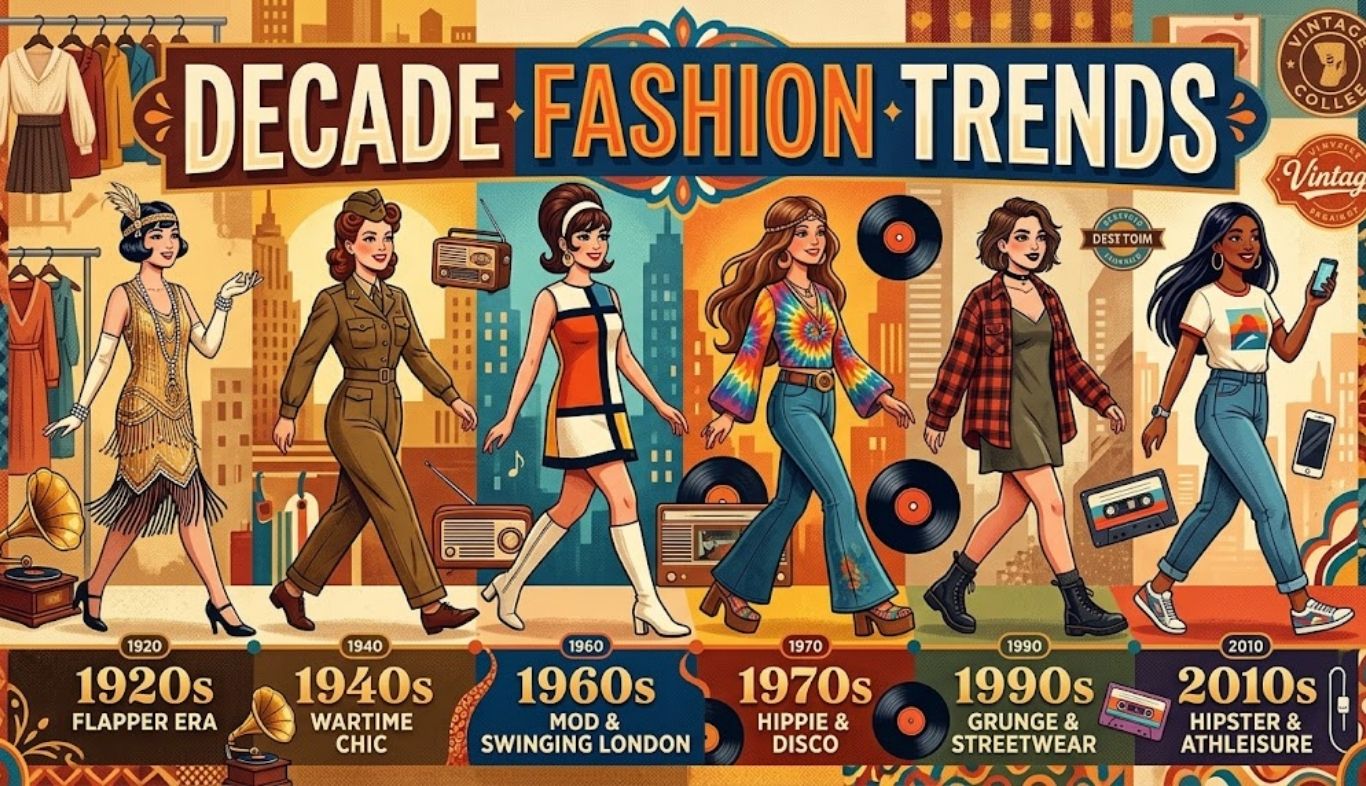
Fashion has never been simply about clothing. Decade Fashion Trends reflect changing lifestyles, technology, music, social movements, economics, and ideas about personal identity. What people wore in one era often tells us just as much about that period as its art, architecture, or popular culture. From the relaxed silhouettes of the 1920s to the bold experimentation of the 1980s and the nostalgic revival of Y2K fashion, every decade has contributed something memorable. Some trends disappeared almost immediately, while others returned years later with a modern twist.
The interesting thing is that fashion rarely moves in a straight line. Designers and consumers constantly revisit the past, remixing old silhouettes with contemporary fabrics, styling techniques, and cultural influences. The Metropolitan Museum of Art has similarly explored fashion as a conversation between past, present, and future, showing how historical garments can influence later designs. This guide explores major fashion trends across the decades, explains why they became popular, and shows how you can adapt their best elements today without looking like you’re wearing a costume.
1920s Fashion: The Rise of the Modern Silhouette
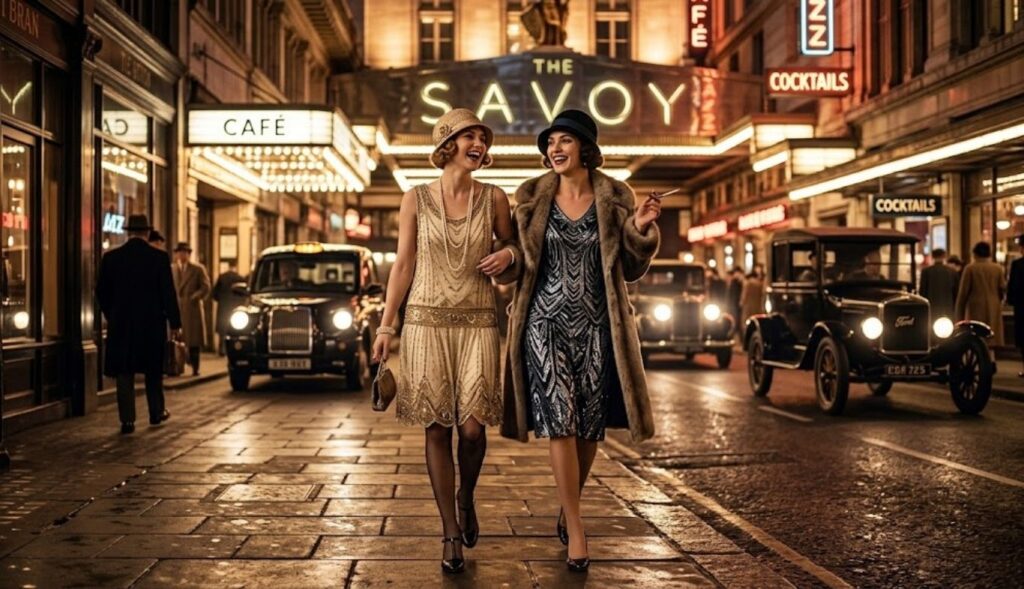
The 1920s brought a dramatic change in women’s clothing. After the restrictions and social upheaval surrounding World War I, fashion moved toward greater freedom of movement and a more youthful appearance. The decade is strongly associated with flapper fashion. Dresses became shorter, waistlines dropped toward the hips, and heavily structured corsetry became less central to the fashionable silhouette. The Metropolitan Museum of Art describes the 1920s silhouette as relatively straight and column-like, with clothing hanging more loosely from the shoulders.
Key 1920s Fashion Trends
- Flapper dresses
- Dropped waistlines
- Beaded eveningwear
- Cloche hats
- Mary Jane shoes
- Long pearl necklaces
- Art Deco-inspired decoration
- Shorter hemlines
- Loose-fitting silhouettes
The decade also helped popularize a more active and socially visible image of women. Clothing had to work for dancing, social events, travel, and increasingly independent lifestyles.
For a modern wardrobe, you don’t need a complete flapper costume. Instead, try a straight-cut dress, metallic accessories, decorative beading, or a simple cloche-inspired hat. A black dress paired with long pearls can create a subtle 1920s reference without looking theatrical.
1930s Fashion: Elegant Glamour and Refined Tailoring
The 1930s shifted away from the loose, boyish silhouette of the previous decade. Clothing became more elegant and body-conscious, while Hollywood had a growing influence on everyday fashion.
Bias-cut dresses were particularly important. They could follow the natural curves of the body while remaining fluid and sophisticated. The decade also favored longer skirts, defined waists, fitted jackets, and glamorous evening gowns.
Signature 1930s Pieces
- Bias-cut gowns
- Wide-leg trousers
- Tailored suits
- Fur-trimmed coats
- Art Deco jewelry
- Elegant evening capes
- High-waisted skirts
- Peplum details
Shoulders and backs became important areas of design. Evening dresses often emphasized a dramatic back, while daytime clothing was more practical and tailored.
The 1930s are a great source of inspiration if you prefer polished outfits. A satin slip dress, pointed shoes, structured handbag, and simple jewelry can capture the decade’s sophisticated mood.
1940s Fashion: Practicality Meets Determination
The 1940s were heavily shaped by World War II. Fashion became more practical because materials were limited and everyday life demanded functionality.
Women’s clothing often featured structured shoulders, shorter skirts, fitted jackets, and utility-inspired details. Clothing needed to be durable and useful rather than excessively decorative.
Important 1940s Trends
| Trend | Description |
|---|---|
| Shoulder emphasis | Created a strong, confident silhouette |
| Utility clothing | Designed around practicality |
| Tailored suits | Offered polished everyday dressing |
| Headscarves | Practical and stylish |
| Midi skirts | Balanced modesty and movement |
| Platform shoes | Added height while saving materials |
| Structured handbags | Combined function with style |
The decade also demonstrated the importance of American sportswear. The Met notes that American sportswear developed strongly from the 1930s onward and emphasized practicality, versatility, and clothing suited to modern lifestyles.
Today, 1940s inspiration works particularly well through high-waisted trousers, tucked-in shirts, structured blazers, and practical accessories.
The key is restraint. One or two historical details can create the feeling of the decade while keeping the overall outfit contemporary.
1950s Fashion: Feminine Shapes and Polished Style
The 1950s are famous for a highly recognizable silhouette. Full skirts, defined waists, fitted tops, and polished accessories became popular, particularly for women’s formal and everyday wardrobes.
Christian Dior’s postwar New Look became one of the era’s most influential fashion references. However, it wasn’t the only style of the decade. American sportswear also offered less structured alternatives, proving that fashion history is rarely as simple as one dominant trend.
Popular 1950s Clothing
- Circle skirts
- Pencil skirts
- Shirt dresses
- Cropped cardigans
- Fitted blouses
- Capri pants
- Cat-eye sunglasses
- Ballet flats
- Waist-cinching belts
Men’s fashion also developed recognizable styles during this period, including tailored suits, leather jackets, bowling shirts, loafers, and casual knitwear.
To modernize the 1950s look, combine a midi circle skirt with a simple fitted T-shirt and contemporary sneakers. The result feels inspired by the era without becoming overly retro.
1960s Fashion: Youth Culture Changes Everything
The 1960s transformed fashion by placing young people at the center of style culture. London became an important fashion hub, and designers such as Mary Quant helped popularize shorter skirts and youthful silhouettes.
The Met’s historical research notes Mary Quant’s importance in the development of the miniskirt, while the broader decade saw a growing rejection of traditional formal dressing.
Defining 1960s Trends
- Miniskirts
- Shift dresses
- Go-go boots
- Bold geometric prints
- Turtlenecks
- Colored tights
- Mod tailoring
- Graphic patterns
The 1960s also embraced experimentation. Fashion became more connected to music, youth movements, art, and changing social attitudes.
A modern 1960s-inspired outfit might include a simple shift dress, opaque tights, ankle boots, and geometric earrings. For something more subtle, choose a single element such as a graphic print or a pair of white boots.
1970s Fashion: Bohemian Freedom and Disco Energy
Few decades offer as much stylistic variety as the 1970s. Bohemian clothing, denim, punk influences, tailoring, and disco fashion all existed within the same broad era.
Early 1970s fashion often favored natural fabrics, flowing shapes, earthy colors, embroidery, and relaxed silhouettes. Later, disco culture introduced sequins, metallic fabrics, fitted trousers, platform shoes, and dramatic eveningwear.
Major 1970s Trends
- Bell-bottom trousers
- Flared jeans
- Maxi dresses
- Suede jackets
- Crochet
- Fringed accessories
- Platform shoes
- Jumpsuits
- Wrap dresses
- Sequined eveningwear
Diane von Furstenberg’s wrap dress became an important example of the decade’s practical yet fashionable approach. American sportswear more broadly had already established clothing that combined comfort, versatility, and modern lifestyles.
The best way to use 1970s inspiration today is to choose your direction. For a bohemian look, try flared jeans, a flowing blouse, and suede-inspired accessories. For disco, use a metallic top, wide-leg trousers, and statement earrings. You can even combine both approaches with a simple denim outfit and one glamorous accessory.
1980s Fashion: Bold Power Dressing
The 1980s were unapologetically bold. Fashion emphasized strong shoulders, dramatic proportions, bright colors, statement accessories, and polished tailoring.
Power dressing became particularly recognizable through structured jackets and suits. Shoulder pads created a broader upper body and gave clothing an assertive shape.
1980s Style Essentials
- Oversized blazers
- Shoulder pads
- Pencil skirts
- Leg warmers
- Statement jewelry
- Bright colors
- High-waisted trousers
- Athletic-inspired clothing
- Bold prints
- Large handbags
The decade also blurred the line between fashion and entertainment. Music television, pop stars, movies, and celebrity culture accelerated trends and helped particular looks reach global audiences.
For a modern interpretation, an oversized blazer is probably the easiest starting point. Wear it with straight-leg jeans and a simple top rather than recreating an entire 1980s outfit.
The Met’s research on twentieth-century silhouettes highlights how the return of shoulder pads in the 1980s changed the relationship between clothing and the body.
1990s Fashion: Minimalism, Grunge, and Street Style
The 1990s pushed back against much of the excess associated with the previous decade. Fashion became more relaxed, minimalist, and influenced by music and street culture.
At the same time, the decade contained several competing aesthetics. Grunge favored flannel shirts, distressed denim, boots, and loose layers. Minimalism preferred clean lines, neutral colors, slip dresses, and understated accessories.
Essential 1990s Trends
| Style | Key Pieces |
|---|---|
| Grunge | Flannel, ripped denim, combat boots |
| Minimalism | Slip dresses, neutral tailoring |
| Preppy | Cardigans, polo shirts, loafers |
| Streetwear | Oversized shirts, sneakers |
| Sporty | Track jackets, cycling-inspired pieces |
| Glam | Satin, fitted dresses, statement accessories |
The decade’s influence remains especially strong because many pieces are easy to wear today. A slip dress with a leather jacket is a simple example. So is an oversized sweatshirt with straight-leg jeans and sneakers.
Rather than copying a celebrity’s exact outfit, focus on the underlying proportions: relaxed layers, simple colors, and comfortable pieces.
2000s Fashion: The Y2K Revival
The early 2000s introduced a highly recognizable combination of technology-inspired optimism, celebrity culture, casual clothing, and glamorous details.
Y2K fashion is now one of the most frequently revived historical aesthetics. Low-rise jeans, tiny handbags, fitted tops, metallic fabrics, denim-on-denim combinations, and decorative accessories are strongly associated with the era.
Popular Y2K Fashion Trends
- Low-rise jeans
- Baby tees
- Mini skirts
- Cargo trousers
- Tiny handbags
- Rhinestone details
- Metallic fabrics
- Velour tracksuits
- Denim jackets
- Chunky sneakers
The important lesson from Y2K fashion is that trends can return without returning exactly as they were. Modern styling often combines Y2K pieces with contemporary proportions. For example, you might wear a cropped top with high-rise trousers rather than reproducing the original low-rise silhouette. This approach makes nostalgic fashion easier to wear and more adaptable to different personal styles.
2010s Fashion: Athleisure and Digital Influence
The 2010s changed how trends spread. Social media, fashion blogs, online stores, and visual platforms allowed people to discover and copy styles faster than ever.
Athleisure became particularly influential. Sneakers, leggings, sweatshirts, bomber jackets, and sports-inspired clothing moved beyond gyms and into everyday wardrobes.
Major 2010s Trends
- Athleisure
- Skinny jeans
- Bomber jackets
- Statement sneakers
- Minimalist accessories
- Streetwear
- Monochromatic outfits
- Oversized coats
- Influencer-inspired fashion
The decade also demonstrated how quickly fashion cycles could accelerate. A look could become popular globally without needing traditional magazine or runway approval.
This digital influence continues today, although consumers increasingly mix online trends with personal style rather than following a single aesthetic.
2020s Fashion: Comfort, Individuality, and Revival
The 2020s have been defined by a mixture of comfort, nostalgia, experimentation, and individual expression. Instead of one dominant look, multiple aesthetics exist simultaneously. Vintage fashion, streetwear, minimalism, maximalism, Y2K, workwear, romantic styles, and sporty clothing can all be seen in modern wardrobes.
Current Fashion Characteristics
- Relaxed tailoring
- Wide-leg trousers
- Vintage-inspired pieces
- Oversized shirts
- Sneakers
- Layering
- Gender-fluid styling
- Secondhand fashion
- Statement accessories
- Mixed-era outfits
The return of historical fashion isn’t surprising. The Met’s work on fashion and duration demonstrates how clothing repeatedly connects the past with the present through shapes, materials, techniques, and decoration. The most exciting part of modern fashion is that you don’t have to choose one decade.
You can wear 1970s-inspired flares with a 1990s-style leather jacket and contemporary sneakers. Or pair a 1950s-inspired skirt with a modern graphic T-shirt. That’s the beauty of today’s fashion landscape: the rules are flexible.
How to Wear Decade Fashion Trends Today
The easiest way to incorporate historical fashion is to avoid wearing too many period-specific pieces at once. Start with one recognizable element.
For example:
- 1920s: Beaded accessories
- 1930s: Bias-cut dress
- 1940s: High-waisted trousers
- 1950s: Full midi skirt
- 1960s: Graphic mini dress
- 1970s: Flared jeans
- 1980s: Oversized blazer
- 1990s: Slip dress
- 2000s: Cargo trousers
Then balance that item with modern basics.
Use the 70/30 Rule
A practical styling method is to make about 70% of an outfit contemporary and 30% vintage-inspired.
For example:
Modern: White T-shirt + straight-leg trousers + contemporary sneakers
Vintage detail: 1970s-inspired suede jacket This keeps the outfit wearable while still communicating the historical reference.
Pay Attention to Silhouette
Decade fashion isn’t only about prints or colors. Shape is often the strongest visual clue. A 1950s outfit feels different from a 1990s outfit largely because of proportions.
When recreating a historical look, ask:
- Where is the waist?
- How wide are the shoulders?
- How long is the hem?
- How fitted is the clothing?
- What type of footwear balances the shape?
Once you understand those elements, you can recreate the spirit of an era without copying every detail.
Common Mistakes When Wearing Vintage-Inspired Fashion
Historical fashion can look fantastic, but there are a few easy mistakes to avoid.
1. Wearing Too Many Era-Specific Pieces
A complete head-to-toe historical outfit may look more like a costume than everyday fashion. Instead, choose one or two strong references.
2. Ignoring Proportion
A vintage item may look unusual if paired with modern clothing that has completely different proportions. Balance oversized pieces with more fitted elements or vice versa.
3. Copying Trends Without Understanding Them
A trend becomes easier to style when you understand why it existed. For example, 1940s utility fashion was shaped by practical needs, while 1980s power dressing communicated confidence and authority. Understanding the context helps you recreate the mood rather than simply copying the surface.
4. Forgetting Comfort
Fashion should work for your real life. If a historical trend isn’t comfortable, adapt it. A modern fabric or contemporary shoe can make a huge difference.
Why Decade Fashion Trends Keep Coming Back
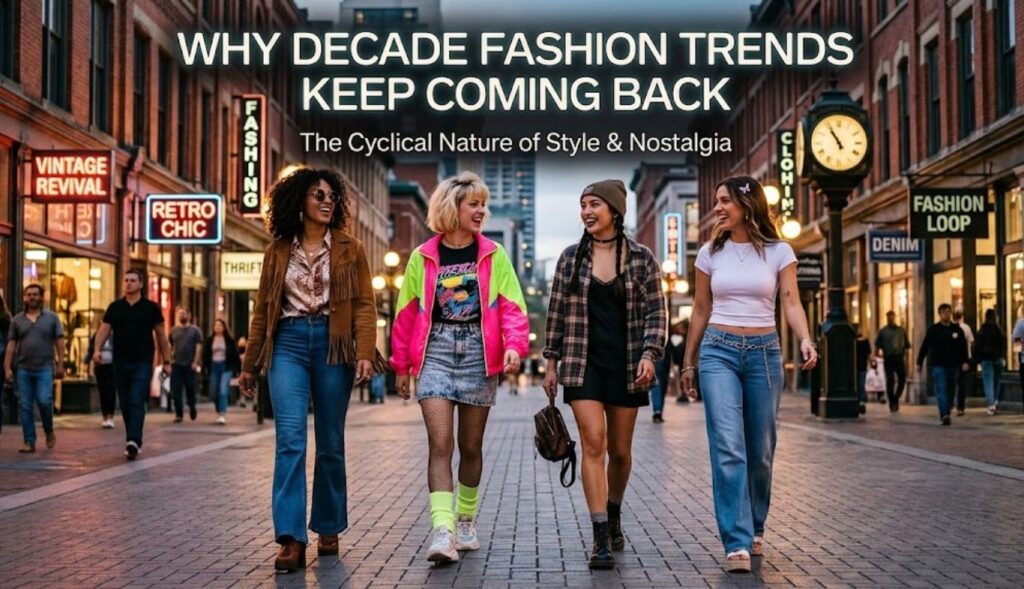
Fashion is cyclical because designers, consumers, and culture continuously reinterpret earlier ideas. A silhouette from one era can become relevant again when social attitudes or lifestyles change. The Met’s research shows how garments from different periods can be connected through recurring shapes, techniques, materials, and decorative ideas.
Nostalgia is another powerful factor. People often become interested in periods they associate with music, films, family photographs, or popular culture. Social media has accelerated this process. Instead of one trend dominating for years, several historical aesthetics can return simultaneously.
That creates a much more flexible fashion environment. For additional historical research, The Metropolitan Museum of Art’s Costume Institute resources provide useful examples of how fashion changes across time.
Frequently Asked Questions
1. What are Decade Fashion Trends?
Decade Fashion Trends are clothing styles, silhouettes, accessories, colors, and cultural influences strongly associated with a particular historical period. Examples include flapper fashion in the 1920s, disco style in the 1970s, power dressing in the 1980s, and Y2K fashion in the 2000s.
2. Which decade had the biggest influence on modern fashion?
There isn’t one definitive answer. The 1990s, 1970s, 1980s, and 2000s have all had major modern revivals. Their influence can be seen in streetwear, denim, tailoring, vintage styling, and contemporary casual clothing.
3. What decade is known for flapper fashion?
The 1920s are best known for flapper fashion. Typical features included loose silhouettes, dropped waistlines, shorter hemlines, decorative beading, and accessories such as cloche hats and long necklaces.
4. Why did fashion change so much in the 1960s?
Youth culture, music, changing social attitudes, new retail models, and designers focused on younger consumers all contributed to major changes. The boutique movement also helped make ready-to-wear fashion more accessible and experimental.
5. What makes 1980s fashion recognizable?
Strong shoulders, oversized blazers, bold colors, statement accessories, fitted skirts, high-waisted trousers, and dramatic proportions are common visual features of 1980s fashion.
6. Is Y2K fashion from the 1990s or 2000s?
Y2K fashion is primarily associated with the late 1990s and early 2000s, particularly styles surrounding the turn of the millennium. Its influence includes low-rise clothing, metallic details, tiny accessories, casual glamour, and technology-inspired aesthetics.
7. How can I wear vintage fashion without looking outdated?
Use one or two vintage-inspired pieces and combine them with modern basics. Updating footwear, accessories, fabrics, and proportions can make historical styles feel contemporary.
8. Which decade is best for casual fashion?
The 1990s are particularly useful for casual inspiration because the decade popularized relaxed denim, sneakers, oversized layers, simple tops, and streetwear-inspired styling. However, 1970s and 2000s trends can also work well for casual outfits.
9. Are decade trends still relevant today?
Absolutely. Modern designers and consumers regularly reinterpret historical silhouettes, colors, fabrics, and accessories. Fashion history continues to provide a huge source of inspiration for contemporary clothing.
10. Can I mix fashion trends from different decades?
Yes. Mixing decades is one of the easiest ways to make vintage-inspired outfits feel modern. A 1970s jacket, 1990s jeans, and contemporary sneakers can work together when the colors and proportions are balanced.
Conclusion
Decade Fashion Trends offer much more than a collection of old clothing ideas. They provide a visual record of how society, technology, music, economics, and personal identity have changed over time. The 1920s introduced relaxed silhouettes and flapper glamour. The 1930s refined elegance. The 1940s prioritized practicality. The 1950s celebrated structured femininity. The 1960s placed youth culture at the forefront. The 1970s embraced freedom and experimentation. The 1980s turned up the volume with power dressing, while the 1990s brought minimalism and streetwear into focus. The 2000s delivered Y2K nostalgia, and later decades accelerated the mixing of historical and contemporary styles.
Today, the best approach isn’t to copy one decade perfectly. Instead, borrow what works. Choose a silhouette you love, add a memorable accessory, modernize the footwear, and make the outfit your own. After all, the most successful fashion trend is the one that feels authentic to the person wearing it. Fashion changes every decade, but great style has a way of coming back around.