
The opposite of gyaru isn’t one officially recognized fashion category. Instead, the phrase is usually used to describe an aesthetic that contrasts with the bold, glamorous, heavily styled appearance associated with gyaru. Depending on the person, that contrast could mean minimalist clothing, natural makeup, classic fashion, normcore, dark academia, or another understated style.
Gyaru is a Japanese fashion subculture known for its emphasis on expressive beauty, styled hair, noticeable makeup, fashionable clothing, and a confident visual presence. However, not everyone wants an eye-catching look. Some people prefer clothes that blend together, neutral colors, subtle makeup, practical hairstyles, or timeless pieces.
That’s where the idea of the opposite of gyaru becomes useful.
Rather than treating it as a strict label, think of it as a style spectrum. At one end, you might find dramatic makeup, elaborate hairstyles, bright fashion, and statement accessories. At the other end, you could find simple silhouettes, muted colors, natural beauty, and minimal accessories.
This distinction matters because fashion isn’t a personality test. Someone can enjoy minimalist clothes one day and dramatic makeup the next. A person doesn’t have to choose one aesthetic forever.
In this guide, we’ll explore seven powerful styles that can reasonably represent the opposite of gyaru, depending on what aspect of gyaru you’re contrasting. We’ll also look at makeup, hair, clothing, lifestyle, and the common misconceptions surrounding these aesthetics.
If you’re researching Japanese fashion subcultures more broadly, learning about the history and cultural context of gyaru can provide useful background.
What Is Gyaru?
Before identifying the opposite of gyaru, it’s important to understand what gyaru actually represents.
Gyaru, also written as gal, developed in Japan as a youth-oriented fashion and cultural movement. Its appearance has changed significantly over the decades, and there are several substyles within the broader gyaru world.
Some versions emphasize:
- Tanned or bronzed skin
- Strong eye makeup
- False eyelashes
- Styled or light-colored hair
- Manicured nails
- Decorative accessories
- Feminine or glamorous clothing
- High-energy presentation
- Strong attention to personal appearance
However, gyaru isn’t simply “wearing lots of makeup.” That’s a common oversimplification.
Different gyaru styles can look dramatically different. Some are glamorous and polished, while others are cute, rebellious, mature, or heavily influenced by particular Japanese fashion trends.
The key idea is intentional visual expression.
Gyaru often celebrates transformation. Hair, makeup, clothing, nails, and accessories work together to create a distinctive appearance. The result can be bold, fashionable, and immediately noticeable.
Therefore, when people search for the opposite of gyaru, they’re usually looking for an aesthetic with contrasting characteristics.
For example, if they want the opposite of dramatic makeup, they may choose a natural makeup style. If they want the opposite of flashy clothing, they may choose minimalist fashion. If they want the opposite of highly styled outfits, they may prefer normcore.
In other words, there isn’t one answer.
What Is the Opposite of Gyaru?
The simplest definition of the opposite of gyaru is an aesthetic that emphasizes restraint, simplicity, natural presentation, or understated styling rather than dramatic glamour.
Still, “opposite” depends on the characteristic you’re examining.
| Gyaru Characteristic | Possible Contrast |
| Bold makeup | Natural makeup |
| Elaborate hair | Simple hairstyle |
| Statement clothing | Minimalist clothing |
| Strong accessories | Few accessories |
| Bright colors | Neutral colors |
| Glamorous appearance | Casual appearance |
| Highly coordinated styling | Effortless styling |
| Trend-focused presentation | Timeless fashion |
This doesn’t mean every minimalist person is the opposite of gyaru. Nor does it mean every gyaru enthusiast rejects simplicity.
Fashion is far too flexible for such rigid rules.
A better way to understand the opposite of gyaru is to ask: Which visual qualities do I want to move away from?
If your answer is “I don’t want dramatic makeup,” natural beauty might suit you. If you say, “I don’t like trendy clothing,” classic fashion could be a better fit. If you prefer loose, ordinary clothes, normcore may be the answer.
That’s why several aesthetics can occupy the opposite end of the spectrum.
7 Powerful Styles That Can Represent the Opposite of Gyaru
1. Minimalist Style
Minimalism is perhaps the clearest answer when someone asks about the opposite of gyaru.
Minimalist fashion focuses on clean lines, simple shapes, restrained colors, and carefully selected pieces. Instead of making every part of an outfit compete for attention, the goal is visual balance.
A minimalist wardrobe might include:
- White shirts
- Black trousers
- Straight-leg jeans
- Simple knitwear
- Neutral blazers
- Plain sneakers
- Small handbags
- Simple jewelry
The beauty of minimalism is that it doesn’t require a complicated formula.
You might wear a cream sweater with black trousers and simple loafers. There may be little makeup, a basic hairstyle, and almost no jewelry. The result is polished without being loud.
This makes minimalist fashion a strong candidate for the opposite of gyaru, especially when the comparison focuses on visual intensity.
However, minimalism doesn’t mean boring.
Fabric quality, tailoring, proportion, and texture can make a simple outfit interesting. A well-cut coat can be more striking than an outfit covered in decorations.
Minimalist fashion also tends to be practical. Pieces can be mixed and matched easily, which makes getting dressed faster.
For someone moving away from a highly styled appearance, minimalism can feel refreshing. You don’t need to abandon fashion. You simply change the way you express it.
2. Natural Style
Natural style focuses on looking fresh, comfortable, and relatively close to your everyday appearance.
This doesn’t necessarily mean wearing zero makeup. Natural makeup can include:
- Lightweight foundation or tinted moisturizer
- Soft blush
- Neutral eyeshadow
- Mascara
- Lip balm or subtle lipstick
- Groomed eyebrows
Hair may be worn in a simple ponytail, loose waves, a bun, or its natural texture.
Clothing often uses comfortable silhouettes and soft colors. Cotton shirts, knit sweaters, jeans, linen trousers, simple dresses, and sneakers can all work.
If the main contrast with gyaru is heavy beauty styling, natural style may be the strongest answer.
The important point is that “natural” doesn’t mean “not fashionable.” A natural aesthetic can still be carefully planned. The difference is that the effort is designed to look subtle.
3. Classic Style
Classic fashion is another compelling alternative.
Classic style relies on clothing that remains attractive beyond a single trend cycle. Think tailored trousers, button-down shirts, trench coats, loafers, structured handbags, simple dresses, and neutral outerwear.
Colors often include:
- Navy
- White
- Black
- Beige
- Gray
- Brown
- Burgundy
Classic fashion can be feminine, masculine, or gender-neutral. It doesn’t have to look formal either.
A simple white shirt and jeans can be classic. So can a tailored suit or an elegant black dress.
Compared with a highly expressive aesthetic, classic fashion feels quieter. Instead of asking, “How can I stand out today?” the approach is often, “How can I look polished without depending on a trend?”
That timeless quality makes classic style a particularly useful interpretation of the opposite of gyaru.
4. Dark Academia
Dark academia provides a more distinctive alternative.
This aesthetic draws inspiration from old libraries, universities, literature, architecture, art, and traditional academic clothing. Its visual language tends to use darker and earthy colors.
Typical colors include:
- Brown
- Charcoal
- Black
- Forest green
- Cream
- Burgundy
Common clothing includes tweed jackets, knit sweaters, pleated trousers, button-down shirts, loafers, long coats, and vintage-inspired accessories.
At first glance, dark academia may not seem like the opposite of gyaru because both can involve carefully coordinated outfits. The difference is in the visual mood.
Gyaru tends toward glamorous and youthful visual energy, while dark academia tends toward intellectual, vintage, and subdued imagery.
So if you want an alternative that’s understated but still expressive, dark academia is worth considering.
5. Normcore
Normcore takes simplicity in a different direction.
Rather than trying to look exceptionally stylish, normcore embraces ordinary, functional clothing. Jeans, plain T-shirts, sweatshirts, basic jackets, sneakers, and baseball caps can form the foundation.
The philosophy is almost refreshingly casual: don’t try too hard.
That makes normcore one of the strongest conceptual opposites of highly styled fashion.
A normcore outfit might consist of:
- Straight jeans
- Gray sweatshirt
- White sneakers
- Basic tote bag
That’s it.
There doesn’t need to be a dramatic color scheme or carefully constructed silhouette.
Normcore also demonstrates why “opposite of gyaru” shouldn’t be interpreted as “bad fashion.” Simplicity can be intentional. Looking ordinary can itself be an aesthetic choice.
6. Gothic Style
Gothic fashion may seem like a surprising answer because it’s visually dramatic. However, it can still be an alternative to gyaru because the two aesthetics often communicate very different moods.
Gothic style commonly uses:
- Black clothing
- Dark makeup
- Silver jewelry
- Lace
- Leather
- Long silhouettes
- Platform footwear
- Victorian or alternative influences
The key distinction is that gothic fashion isn’t necessarily understated. Instead, it represents a different kind of intensity.
If someone asks for the opposite of gyaru because they want to escape a traditionally glamorous or bright appearance, gothic fashion can provide a dramatic alternative without becoming minimalist.
It’s a reminder that opposite aesthetics don’t always have to be visually quiet.
7. Clean Girl Style
Clean girl style is a modern aesthetic built around polished simplicity.
Its typical visual elements include:
- Sleek hair
- Minimal makeup
- Neutral clothing
- Simple jewelry
- Clean sneakers or sandals
- Coordinated basics
- Fresh-looking skin
This aesthetic overlaps heavily with minimalism and natural beauty.
However, there’s an important distinction: clean girl styling can be highly curated. The outfit may look effortless, but considerable thought can go into achieving that “effortless” appearance.
For someone searching for the opposite of gyaru, clean girl style may work particularly well when the desired change involves less dramatic makeup and simpler styling.
Beauty Differences: Makeup, Hair, and Accessories
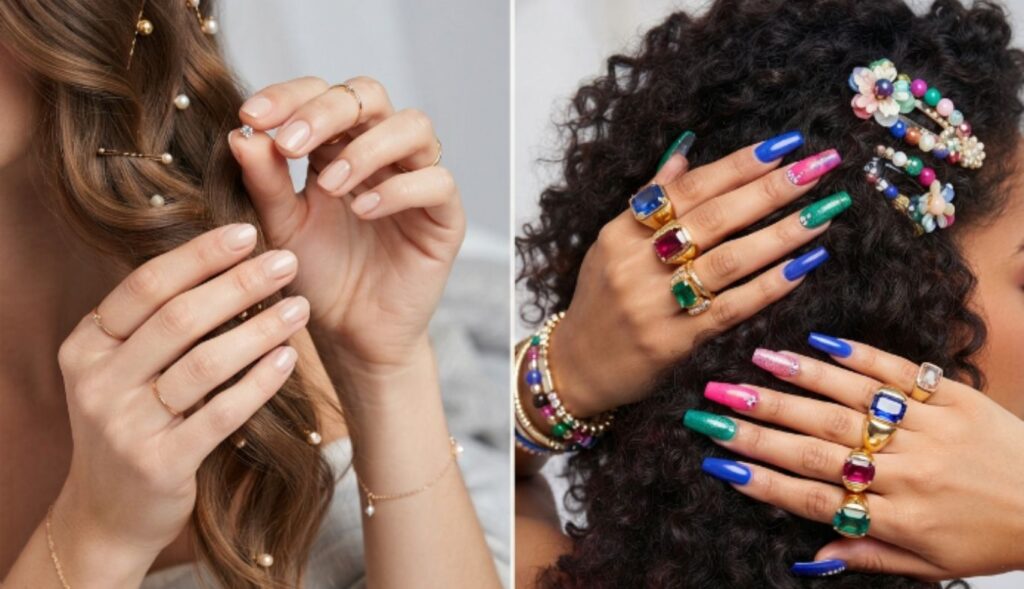
One of the easiest ways to understand the opposite of gyaru is through beauty styling.
Gyaru-inspired beauty often places strong emphasis on the eyes, hair, lashes, nails, and overall transformation. An alternative approach reduces visual intensity.
Makeup
A contrasting makeup routine might focus on:
- Lightweight base
- Natural-looking brows
- Soft blush
- Neutral eyeshadow
- Minimal eyeliner
- Mascara
- Sheer lip color
The goal isn’t necessarily to look completely makeup-free. Instead, the makeup should appear subtle.
Hair
Highly styled hair can be replaced with:
- Natural texture
- Simple ponytails
- Low buns
- Straight hair
- Loose waves
- Short practical cuts
Again, the point isn’t that one is better. They’re simply different ways of communicating style.
Accessories
Instead of layered necklaces, statement earrings, decorative nails, and elaborate handbags, an understated wardrobe might use:
- A simple watch
- Small earrings
- One necklace
- A plain belt
- A basic tote
- Minimal hair accessories
Sometimes one carefully selected accessory has more impact than five competing pieces.
Personality and Lifestyle: Don’t Confuse Fashion With Character
There’s an important misconception worth clearing up.
The opposite of gyaru isn’t a personality type.
Someone who dresses minimally isn’t automatically shy. Someone who wears bold gyaru fashion isn’t automatically outgoing. Clothing provides clues about visual preferences, but it doesn’t tell you everything about a person’s character.
A minimalist can be adventurous. A gyaru enthusiast can be quiet and introverted. A person can also enjoy completely different aesthetics depending on the occasion.
This matters because fashion subcultures are often simplified into stereotypes.
Instead of saying:
“Gyaru people are like this.”
It’s more accurate to say:
“This style commonly emphasizes these visual elements.”
That distinction makes fashion discussions more respectful and accurate.
How to Choose the Right Alternative Style
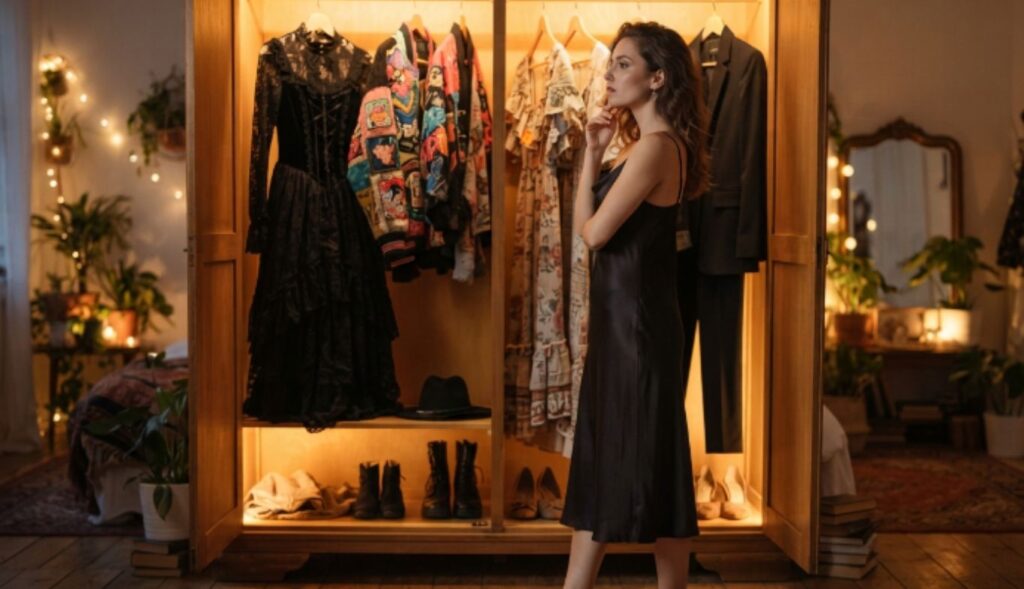
If you’re looking for the opposite of gyaru, don’t start by asking which aesthetic is “correct.” Start by identifying what you want to change.
If you want less makeup
Try natural or clean girl styling.
If you want simpler clothing
Try minimalism.
If you want timeless outfits
Try classic fashion.
If you want relaxed clothing
Try normcore.
If you want something dark
Try gothic or dark academia.
If you want a polished appearance
Try classic or clean girl styling.
You can also combine them.
For example, you might create a wardrobe that’s:
70% minimalist + 20% classic + 10% dark academia.
There are no fashion police waiting to issue a ticket.
Your aesthetic should support your lifestyle rather than make your life harder.
Gyaru vs. Alternative Aesthetics: Quick Comparison
| Feature | Gyaru | Minimalist | Natural | Classic | Normcore | Gothic |
| Makeup | Often noticeable | Subtle | Light | Polished | Minimal | Can be dramatic |
| Hair | Highly styled | Simple | Natural | Neat | Casual | Styled/dark |
| Colors | Often expressive | Neutral | Soft | Neutral | Basic | Dark |
| Accessories | Statement pieces | Few | Few | Refined | Minimal | Bold |
| Clothing | Fashion-forward | Clean | Relaxed | Timeless | Casual | Alternative |
| Visual impact | High | Low | Low | Medium-low | Low | High |
| Main mood | Glamorous | Clean | Fresh | Elegant | Casual | Dramatic |
This table shows why there isn’t a single universal opposite of gyaru.
Different aesthetics contrast with different parts of the gyaru look.
Common Mistakes When Defining the Opposite of Gyaru
Mistake 1: Assuming There’s One Official Opposite
There isn’t a universally accepted fashion category called “anti-gyaru.”
The phrase is descriptive rather than a formal classification.
Mistake 2: Equating Minimalism With Plainness
Minimalist fashion can be sophisticated. Fit, fabric, color, and proportion still matter.
Mistake 3: Assuming Natural Means No Makeup
Natural makeup can involve several products. The difference is usually the visual effect.
Mistake 4: Treating Aesthetics as Permanent Identities
You can enjoy gyaru-inspired makeup on Friday and minimalist clothing on Saturday.
Fashion is flexible.
Mistake 5: Ignoring Cultural Context
Gyaru developed within Japanese youth culture and has a history that goes beyond social-media aesthetics. Reducing it to makeup alone misses much of the story.
Frequently Asked Questions
1. What is the opposite of gyaru?
The opposite of gyaru isn’t one official aesthetic. Minimalist, natural, classic, normcore, and clean girl styles are common answers when someone means a less dramatic and more understated appearance.
2. Is minimalist fashion the opposite of gyaru?
It can be. Minimalism contrasts with many highly expressive gyaru looks through neutral colors, simple silhouettes, fewer accessories, and understated beauty. However, it isn’t the only possible opposite.
3. What Japanese style is opposite to gyaru?
There isn’t one universally recognized Japanese style that serves as the official opposite of gyaru. Depending on the characteristic being contrasted, people may point to more understated or traditional Japanese fashion approaches.
4. Is natural makeup the opposite of gyaru makeup?
Natural makeup can be considered a contrast to more dramatic gyaru makeup. It generally uses lighter coverage, softer eye definition, subtle blush, and understated lip colors.
5. Can someone like gyaru and minimalist fashion?
Absolutely. Fashion preferences aren’t mutually exclusive. Someone can enjoy bold gyaru-inspired outfits for special occasions and minimalist clothing for everyday life.
6. Is dark academia the opposite of gyaru?
Dark academia can be an alternative because its visual language is usually darker, more intellectual, vintage-inspired, and subdued. However, it’s still a highly curated aesthetic, so it isn’t the opposite in every sense.
7. What is the most understated alternative to gyaru?
Normcore and minimalist fashion are among the most understated choices. Normcore focuses on ordinary, practical clothing, while minimalism focuses more strongly on clean design and intentional simplicity.
8. Does dressing opposite to gyaru mean avoiding makeup?
No. The concept is about aesthetic contrast, not eliminating beauty products. You can wear makeup while choosing a softer, more natural appearance.
Conclusion
The opposite of gyaru isn’t a single, officially defined fashion style. Instead, it can refer to any aesthetic that contrasts with the bold makeup, glamorous styling, expressive clothing, and highly polished appearance often associated with gyaru. Depending on what you’re looking for, minimalist, natural, classic, normcore, clean girl, dark academia, or gothic fashion can all provide a different kind of contrast.
If you prefer simplicity, minimalist fashion may be the best choice. If you want a softer and more natural appearance, try natural or clean girl styling. For timeless elegance, classic fashion is an excellent option, while normcore works well for people who value comfort and practicality. On the other hand, dark academia and gothic fashion offer distinctive alternatives for those who still want a strong visual identity.
Ultimately, fashion doesn’t have to fit into one box. You can combine different aesthetics, change your style over time, and choose what makes you feel confident and comfortable. The goal isn’t necessarily to become the exact opposite of gyaru. It’s to discover an aesthetic that reflects your own taste and personality.
Whether you prefer understated basics or dramatic alternative fashion, there’s no wrong way to express yourself. Your personal style is yours to define.